
AI agent guardrails keep a worker inside its assigned lane by defining its authority, allowed paths and tools, forbidden control-plane actions, and a small test it must pass before receiving broader access. A role description is not enough once an agent can edit files or run commands. The boundary has to be written so the operator can inspect it, test it, and tighten it when the worker presses against the edge. That practical containment layer sits underneath the broader hybrid agentic stack architecture.
Key takeaways
- Give each worker one job and one authority owner.
- Allow only the paths, tools, and commands required for that job.
- Explicitly deny configuration changes, service restarts, routing, and agent triggers unless those actions belong to the worker.
- Test the fence with a tiny reversible task before expanding access.
- Treat every unexpected access attempt as evidence that the written rule needs work.
What are AI agent guardrails?
AI agent guardrails are enforceable limits on an agent’s authority, access, and actions. They specify what the worker may read or change, which tools it may use, what it must never control, and what proof it must return after a task.
The word enforceable matters. “You are the coding agent” is a label. “You may edit these two directories, may run these three verification commands, and may not touch configuration, restart services, trigger agents, or change routing” is an operating boundary.
This is narrower than deciding where a human approval gate belongs. Approval gates answer when work must stop for a person. Guardrails answer what the worker can reach before that question even comes up. If you are still deciding which layer should own workflow control, start with the explanation of why the orchestration layer should remain separate from worker tools. Once that ownership is clear, the next job is turning it into access rules.
Why doesn’t a good prompt keep an agent in its lane?
A prompt can describe intent, but intent is not a permission model. A capable worker may still interpret a broad objective in ways the operator did not expect. “Fix the pipeline” could mean editing one script, changing a shared configuration file, restarting a service, or triggering a new run. Each action might look reasonable from the worker’s local view while crossing the system’s authority boundary.
The fix is not a longer personality prompt. The fix is a short job contract that answers four concrete questions:
- Who decides? Name the layer or person that owns routing and scope changes.
- What may this worker touch? List exact paths, tools, and commands.
- What is outside the lane? Name forbidden paths and actions, including tempting shortcuts.
- How will the operator verify the result? Require changed files, checks run, results, assumptions, and blockers.
That contract does create some setup work. It also removes repeated interpretation. The first task takes longer to specify; later tasks become easier to route because the worker and operator share the same fence.
How should authority be divided before access is granted?
Start with authority, not tool names. The supplied Hybrid Agentic Stack Blueprint uses three distinct layers: a decision layer that owns intake and routing, a live-control lane for actions that need immediate operator awareness, and a background coding lane for scoped file work. The specific software can change. The separation should not.
A useful division looks like this:
| Lane | Owns | Must not absorb |
|---|---|---|
| Decision layer | Intake, routing, memory, timing, and next-owner decisions | Routine bulk implementation or silent publication |
| Live-control lane | Interactive debugging, logs, deliberate configuration work, and supervised triggers | Strategy ownership or long batches of predictable edits |
| Scoped production worker | Defined file changes, scripts, structured rewrites, and post-task verification | Routing, approvals, service control, or configuration outside its assignment |
One owner should remain responsible for changing the assignment. A worker should not expand its own scope because the requested result would be easier with more access. It can report the dependency and stop. The authority owner then decides whether to amend the task, move it to another lane, or keep the boundary in place.
This is the part people sometimes mistake for bureaucracy. It is closer to basic job design. A bookkeeper does not need deployment credentials. A coding worker does not need to own the router. Clear limits make specialization useful because one worker’s mistake cannot quietly become a system-wide decision.
Write an allowlist that matches the actual task
An allowlist should be small enough to inspect and broad enough to complete the assigned job. Avoid granting access to an entire workspace when the task concerns one project directory. Avoid allowing every shell command when the worker needs only a formatter, a test command, and a read-only inspection command.
Allow paths by purpose
List the directories the worker may read and the narrower set it may write. Reading and writing are different permissions. A worker may need to inspect a source brief but should not be allowed to rewrite it. It may need to update application files but have no reason to touch shared credentials, orchestration state, or another project’s artifacts.
Allow tools by task
Grant the tools needed for the outcome, not every tool available in the environment. A file-editing task may need search, edit, and test capabilities. It does not automatically need browser control, outbound messaging, scheduling, or deployment access.
Allow commands by consequence
Separate inspection commands from mutation commands. Reading a log is different from restarting the process that produced it. Running a syntax check is different from changing a live configuration. If a command affects services, routing, credentials, publication, or external systems, it belongs in a different risk class than a local test.
The broader small-business agentic system build guide covers the overall sequence from use case through testing and handoff. At the worker level, the same principle becomes more precise: give the smallest useful surface, prove it works, then widen it only when a real task requires more.
Which no-cross rules belong in every worker contract?
No-cross rules name actions that remain outside the lane even when they appear to help the task. They remove the worker’s need to guess whether a shortcut is acceptable.
For a scoped coding or automation worker, the contract should usually address these areas explicitly:
- Configuration: Do not edit orchestration or system configuration unless the task names the exact file and the control owner authorizes it.
- Service control: Do not restart gateways, workers, schedulers, or other services.
- Agent control: Do not launch, trigger, stop, or reroute other agents.
- Scheduling: Do not create or modify cron jobs, queues, or publication schedules.
- Credentials: Do not print, copy, relocate, or broaden access to secrets.
- Shared state: Do not rewrite memory, routing records, approval status, or another worker’s artifacts.
- External effects: Do not publish, send, purchase, delete remote data, or change a live account.
A denial should be specific enough that the worker can recognize it. “Do nothing risky” forces the worker to invent the risk model. “Do not edit the router configuration or restart the gateway” names the boundary in terms of actions and targets.
The Hybrid Agentic Stack Blueprint includes a written worker guardrail and a three-layer no-cross model for this exact problem. If you need a starting structure for mapping the decision, control, and coding lanes, review the Hybrid Agentic Stack Blueprint. It is an owned Piscion Global product, not an affiliate recommendation.
How do you apply least access without making the worker useless?
Least access does not mean giving the worker almost nothing. It means every permission has a current reason. Start from the task’s required inputs, operations, and outputs, then grant access that maps to those needs.
Suppose the task is to improve error messages in a local script. The worker may need to read the script, edit that project directory, inspect a small test fixture, and run a syntax check. It does not need the full home directory, production credentials, the orchestration configuration, or permission to restart a live service. If the syntax check exposes a runtime issue that requires a restart, the worker reports that fact instead of taking the control-plane action.
Keep source material separate from generated work where possible. Read-only source folders preserve provenance. Task-specific output directories make the changed surface obvious. Credentials should remain outside both unless the job genuinely requires authenticated access, and even then the worker should receive only the minimum credential scope.
The main objection is speed: broad access appears faster because there are fewer boundaries to write. That advantage disappears when the operator must inspect an unknown number of touched files or determine whether the worker changed system state. A narrow fence makes verification cheaper. It also makes failures easier to undo.
What does a concrete worker guardrail look like?
Here is a worked example for a coding worker assigned to add retry logging to one script. The paths are illustrative; replace them with the exact paths in your own environment.
Task: Add clear retry logging to scripts/pipeline-runner.py
Authority owner: Orchestrator

Allowed reads:
- /workspace/project/scripts/
- /workspace/project/tests/fixtures/retry-case.json

Allowed writes:
- /workspace/project/scripts/pipeline-runner.py
- /workspace/project/tests/test_retry_logging.py

Allowed commands:
- search and file inspection
- python syntax check
- targeted retry-logging test

Forbidden:
- orchestration configuration
- service or gateway restarts
- agent and schedule triggers
- credentials and shared state
- files outside the two allowed write paths

Return:
- summary
- exact files changed
- verification commands and results
- assumptions and blockers
This contract does not tell the worker how to write the code. It defines the job boundary and the evidence expected at handoff. The worker still has room to solve the implementation problem, but it cannot quietly turn a script change into a routing or service-control decision.
If the worker discovers that the retry count comes from a forbidden configuration file, it should not edit that file. It should report the dependency: “The requested log can be added, but changing the retry count requires a control-lane configuration change.” That is a successful boundary response, not a failure to finish.
How do you test the fence before assigning real work?
- Choose a reversible target. Use a scratch file, test fixture, README, or isolated copy inside the allowed path.
- Give one narrow outcome. Ask for a small change that can be inspected in seconds.
- Include one tempting boundary. Make sure a related but forbidden configuration or shared file is visible in the task context without asking the worker to touch it.
- Require a receipt. Ask for changed files, commands run, results, assumptions, and blockers.
- Inspect the touched surface. Confirm the worker changed only allowed paths and did not trigger side effects.
- Expand one dimension at a time. Add a path, tool, or command only when a new task requires it.
The test is not whether the output looks correct. The test is whether the worker produced the result while respecting the fence. A perfect file delivered after an unauthorized service restart is not a clean pass.
Also inspect attempted actions, not just final files. A blocked attempt to access a credential directory is useful evidence. It shows either that the task packet was ambiguous or that the rule needs to be stated more plainly. Record the pressure and revise the contract before moving to higher-impact work.
Turn boundary pressure into a better rule
Guardrails improve through observed edge cases. When a worker asks for a new path, tries an unnecessary command, or reports that a forbidden action would make the task easier, do not immediately widen access. First determine which of three things happened:
- The task truly requires a new permission.
- The task belongs in another lane.
- The worker found a shortcut that is convenient but not necessary.
If the permission is necessary, add the smallest specific exception and record why. If the work belongs elsewhere, reroute it. If it is only a shortcut, keep the denial and clarify the expected alternative. This turns surprises into durable operating knowledge instead of one-off chat corrections.
Do not let exceptions become invisible defaults. “Allowed once for task 27” is different from “this worker may always restart services.” The first is an auditable decision. The second changes the worker’s role.
Where the Hybrid Agentic Stack Blueprint fits
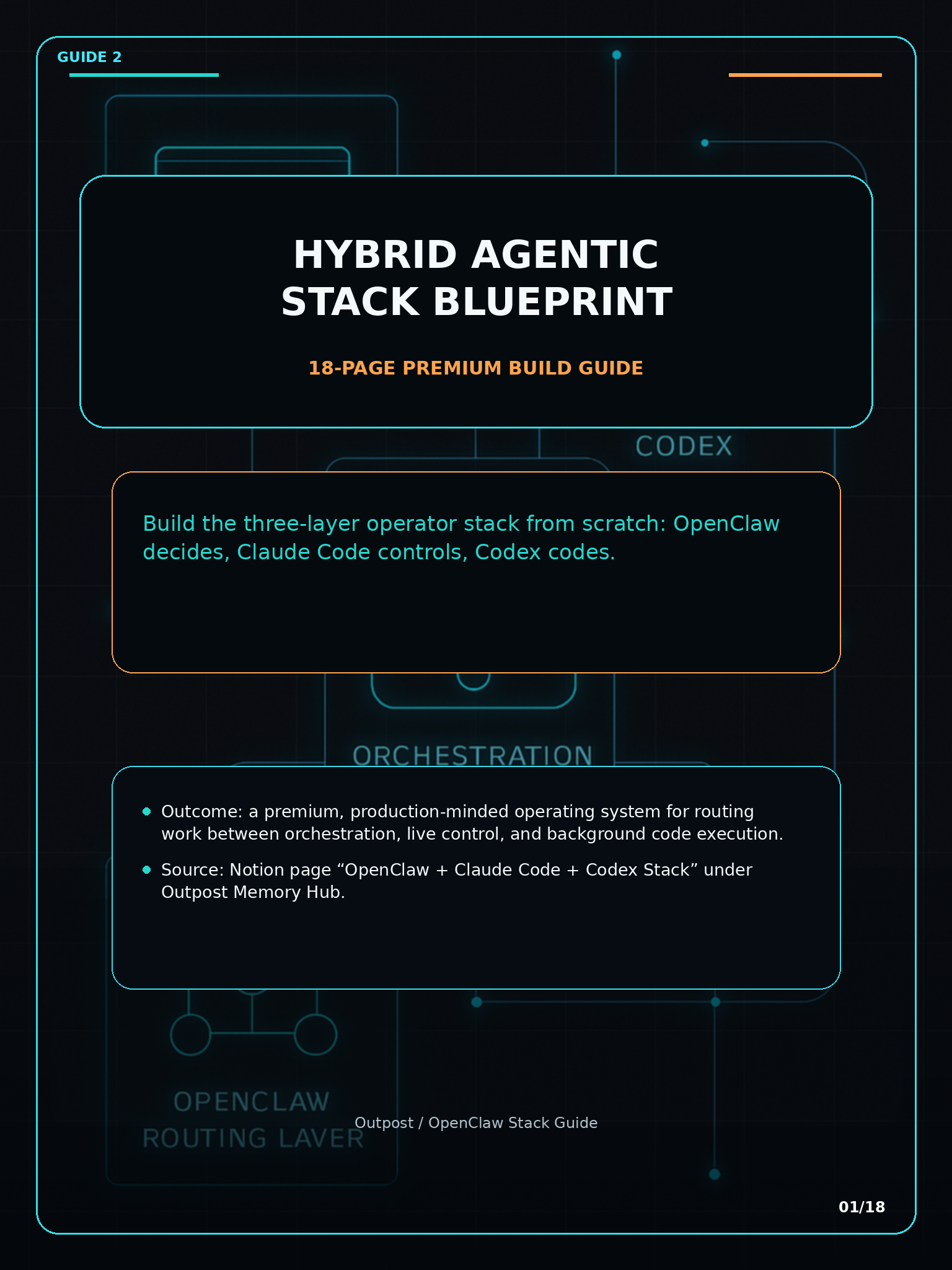
The Hybrid Agentic Stack Blueprint is an 18-page guide for separating decision authority, live control, and background coding work. It includes the three-layer mental model, a written worker guardrail, routing rules, no-cross rules, a safe first-task sequence, and a review receipt structure.
It is useful if you already know you need multiple specialized AI lanes but do not want to invent their boundaries from scratch. It is not a security platform, permission engine, or substitute for operating-system controls. You still have to adapt the example paths, tools, commands, and enforcement mechanisms to your environment. It also will not decide your business process for you. The value is the operating model and the written starting point.
The verified catalog price is $49. I built the guide for operators who want a concrete map for the stack before giving workers broader access. If that matches the system you are assembling, get the Hybrid Agentic Stack Blueprint here.
About the author: Chris Myers builds AI-powered business systems for lean operators and writes at Piscion Global.
The practical next step: Write one worker contract today. Name the authority owner, allowed paths, allowed tools, forbidden control-plane actions, and proof required at handoff. Then run a reversible task and inspect every touched path. If you want the full three-layer model beside you while you do it, use the Hybrid Agentic Stack Blueprint as your working map.