
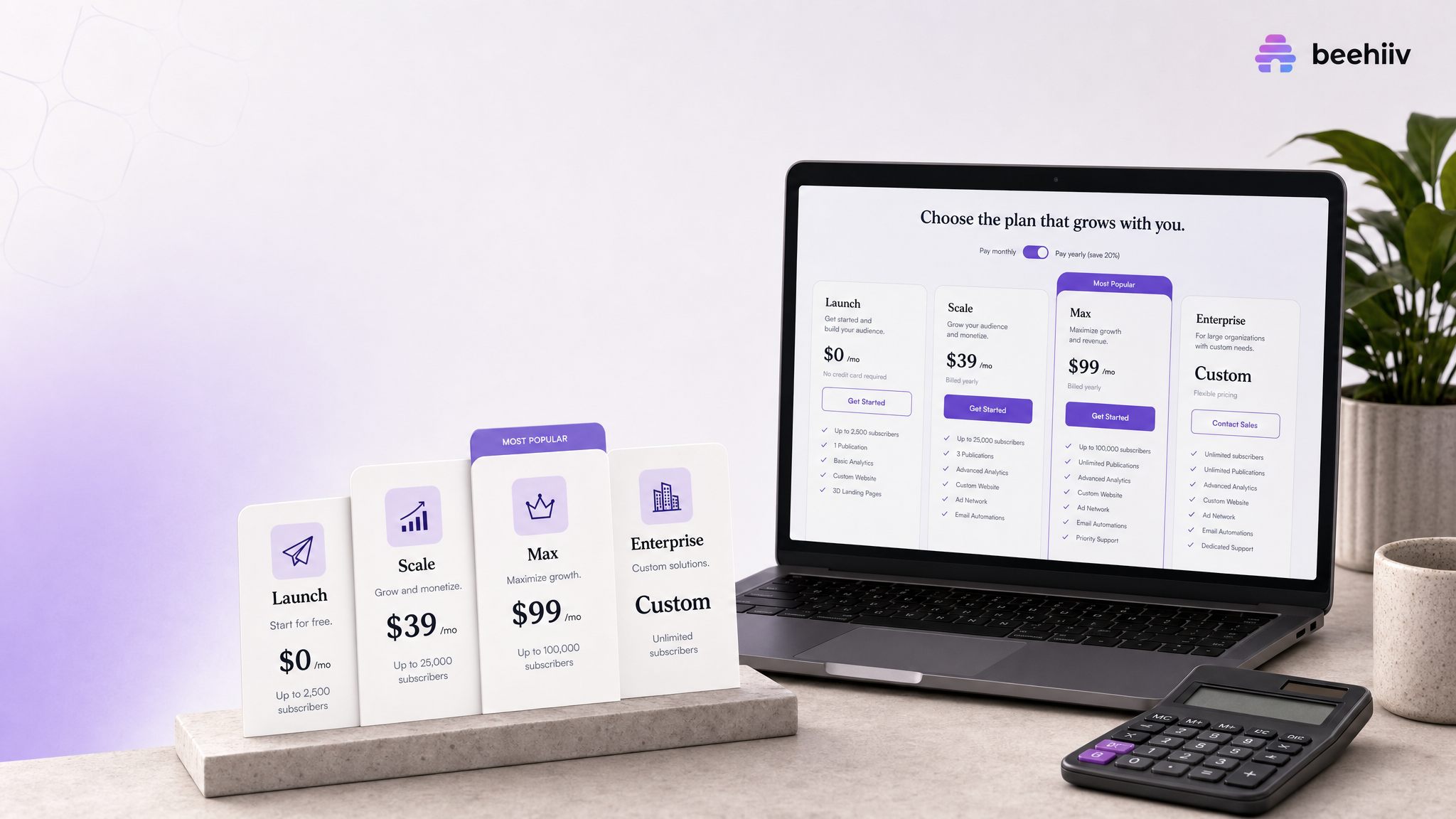
Is beehiiv Worth the Price? A Straight Cost-Value Breakdown
Pricing is where people get honest. A tool can look good, sound good, and still miss the mark if the monthly cost does not match the stage of the business. That is why beehiiv pricing is the part I would look at first, not last.
I am not interested in paying for a newsletter tool because it is trendy. I want to know whether the cost lines up with the value I get as a solo operator. That is why I kept checking beehiiv and the pricing page before I said anything useful about it.
If you are in the same spot, the question is simple: is the free start enough, and if not, does the paid jump make sense? That is the part that decides whether the tool is useful or just another expense.
Quick answer:
- What the free plan changes.
- When the paid plan starts to matter.
- What value looks like for a solo newsletter.
- What the partner program means.
- Beehiiv Pricing: Pricing and partner terms.
What the free plan changes
The free plan changes the starting line. That matters more than people think. When you are building a list from scratch, being able to test the tool without an upfront bill reduces pressure.
The main thing I like about that is timing. You can validate the habit, not just the software. If you cannot stay consistent on the free plan, a paid plan will not fix that.
When the paid plan starts to matter
beehiiv’s paid plans start at $49 per month. That is not huge in abstract terms, but it is real money when you do not have a newsletter yet. I would want a clear reason before I moved there.
The right reason is usually one of three things: you have enough readers to justify it, you want a feature or workflow that saves time, or the newsletter is already part of the business model and the platform is doing real work for you.
If none of those are true, I would stay on the free plan longer.
What value looks like for a solo newsletter
For me, value is not a shiny dashboard. Value is whether the tool helps me send more consistently without making the process heavier.
That is the real cost question. If beehiiv keeps the workflow simple, saves time, and helps me keep the list alive, then the monthly cost has a job to do. If it becomes another thing I have to manage, the price is too high no matter what the invoice says.
The best use case is a lean newsletter business where the tool needs to stay out of the way. If that is the model, the price makes more sense.
Beehiiv Pricing is worth understanding before you commit to any newsletter stack.
For a solo newsletter operator, beehiiv pricing is the question worth spending time on before you pick a platform.
What the partner program means
The partner program is worth mentioning because it is public and clear. The official partner page is here: https://www.beehiiv.com/partners.
The current verified terms are that the program advertises up to 60% commissions for 12 months, with monthly payouts via PayPal around the 15th.
The tiers break down like this. Bronze covers your first 1–99 conversions and pays 50% commission for 12 months per referral. Silver runs from 100–199 conversions at 55%. Gold is 200 or more conversions at the full 60%. There is also a one-time $100 merchandise credit if you make your first conversion within 90 days of joining. Payouts go out monthly via PayPal around the 15th. Those are the numbers from beehiiv’s own partner communications — straightforward enough that I do not need to editorialize them.
That does not change my recommendation logic. I still would not choose a tool because of the commission. But if you do write about it, those terms are part of the value conversation and they should be stated plainly.
Beehiiv Pricing: Pricing and partner terms
The official pricing page is here: https://www.beehiiv.com/pricing. The facts that matter are simple: beehiiv has a free plan, and paid plans start at $49 per month.
If I were writing this as a decision memo, I would write the rest of the note around those two lines. The free plan is the entry point. The paid plan is the threshold where the decision becomes real.
My honest take on the tradeoff
Is beehiiv worth the price? Sometimes yes, sometimes no.
It is worth it if you are trying to keep a newsletter lean and you want a tool that does not make the early stage expensive. It is not worth it if you are paying for features you do not use or if you are still too early to justify the monthly cost.
That is my real answer. Use the free plan if you are still testing the habit. Upgrade when the newsletter is doing enough work to justify the bill.
The break-even question I would ask
If I were deciding on beehiiv for real, I would ask a break-even question instead of a hype question. How much time or frustration does the tool save me each month, and is that worth more than the monthly cost?
That is the better way to think about newsletter software for a solo business. A tool is not just a line item. It is also the number of minutes it saves, the number of sends it helps me complete, and the amount of mental friction it removes when I am tired.
Most people searching beehiiv pricing are trying to avoid a platform switch six months down the road.
That is one reason beehiiv pricing keeps coming up in these conversations.
For a lean operator, the payoff usually comes from a few simple things:
– fewer tools to manage
– less time bouncing between platforms
– a clearer path from draft to send
– a free starting point while the list is small
– a paid path only when the list or workflow justifies it
That is why I would not upgrade early just because the paid plan exists. I would wait until the newsletter was doing enough work to make the subscription feel normal.
I would also be careful not to mix up “worth it” with “cheap.” Cheap can still be a bad buy if it slows me down. And an expensive tool can still be worth it if it keeps me publishing.
The thing I like about beehiiv is that the pricing question is clear. Free plan first. Paid at $49/month when you need it. No mystery, no magic. That makes the decision easier.
The simple math I would run
If I were deciding whether to pay for beehiiv, I would run a very plain math test. How much time does it save me each month? How often does it help me publish? How much frustration does it remove from the process? If I cannot point to those things, I am probably paying too soon.
That is the practical way to look at newsletter software. A subscription is justified when the tool helps the business move, not when it just looks like a professional choice. I would rather keep the money in my pocket until the platform has earned a place.
For a solo operator, that usually means the free plan gets you through the proving stage. It lets you test the habit, the voice, the audience, and the workflow without pressure. If the newsletter starts to matter, the paid plan becomes easier to justify.
I would also think about the cost of not upgrading. If a paid plan saves enough time that I can write better issues or stay consistent longer, that is worth considering. But I would still wait for the evidence. I do not like paying for imagined future value.
The good news is that beehiiv makes the threshold obvious. There is a free start. The paid line begins at $49 per month. I do not have to guess what the next step costs.
And if I ever wanted a sanity check, I would ask one question: would I still choose this if I were paying from my own pocket and no one was watching? If the answer is yes, then the price is probably fine.
The short answer on beehiiv pricing is that the free plan buys you enough runway to find out.
That is the answer I trust.
For a solo operator, beehiiv pricing is the comparison that tends to matter most.
When I would not pay yet
I would not pay yet if the newsletter was still in the idea stage, if I had not sent a few real issues, or if I was still changing direction every week. In that stage, paying for software is usually just a way to feel like progress is happening.
I would also hold off if I knew I was not going to use the platform regularly. A subscription only makes sense when the habit is real. If I am not publishing, I am not getting value.
That sounds blunt, but it is the honest version. A lot of solo founders spend too early because it feels professional. I would rather be a little slower and a lot clearer.
The upside of beehiiv is that it makes that restraint possible. The free plan lets me wait until the work justifies the bill. That is a healthier starting point than paying first and hoping the habit appears later.
So the price question is not “Is $49 expensive?” The real question is “Has the newsletter reached the point where this solves a real problem for me?” If yes, I can justify it. If no, I can keep the free plan and keep moving.
That is the line I would use.
And that is usually where the right answer becomes obvious.
It is the cleanest way I know to make the call.
What the beehiiv Partner Program Actually Pays
If you sign up through an affiliate link, here is how the partner program works. beehiiv runs a tiered commission structure based on total conversions:
- Bronze (1–99 conversions): 50% commission for 12 months
- Silver (100–199 conversions): 55% commission for 12 months
- Gold (200+ conversions): 60% commission for 12 months
There is also a $100 beehiiv merch credit when you make your first conversion within 90 days. Commissions apply to paid plan revenue — not a cut of your subscriber revenue. Payouts go out monthly around the 15th via PayPal.
If you want to try it yourself, beehiiv’s free plan covers up to 2,500 subscribers — plenty of runway before you pay anything.
Disclosure: If you use my link, I do get a commission. The price is the same to you either way, and I am not going to dress that up.
Want the bigger picture before you weigh beehiiv pricing? Read my honest beehiiv review and the beehiiv vs ConvertKit pricing comparison to see how the plans stack up against the value you actually get.
About the author: Chris Myers builds AI-powered business systems and tests every tool in his own solopreneur stack before recommending it. He writes at Piscion Global.
Pingback: Beehiiv Review: What It Actually Feels Like for a Solo Newsletter - Piscion Global
Pingback: How I’d Use beehiiv Day to Day as a Solopreneur - Piscion Global
Pingback: Beehiiv Setup Guide for Solopreneurs Who Want a Simple Newsletter Stack
Pingback: Beehiiv vs ConvertKit vs Mailchimp: The Comparison I’d Actually Use
Pingback: Beehiiv vs Substack: Which One Actually Fits a Solopreneur Stack?