
Revid.ai Music to Video: Make Audio-Led Promo Clips Faster
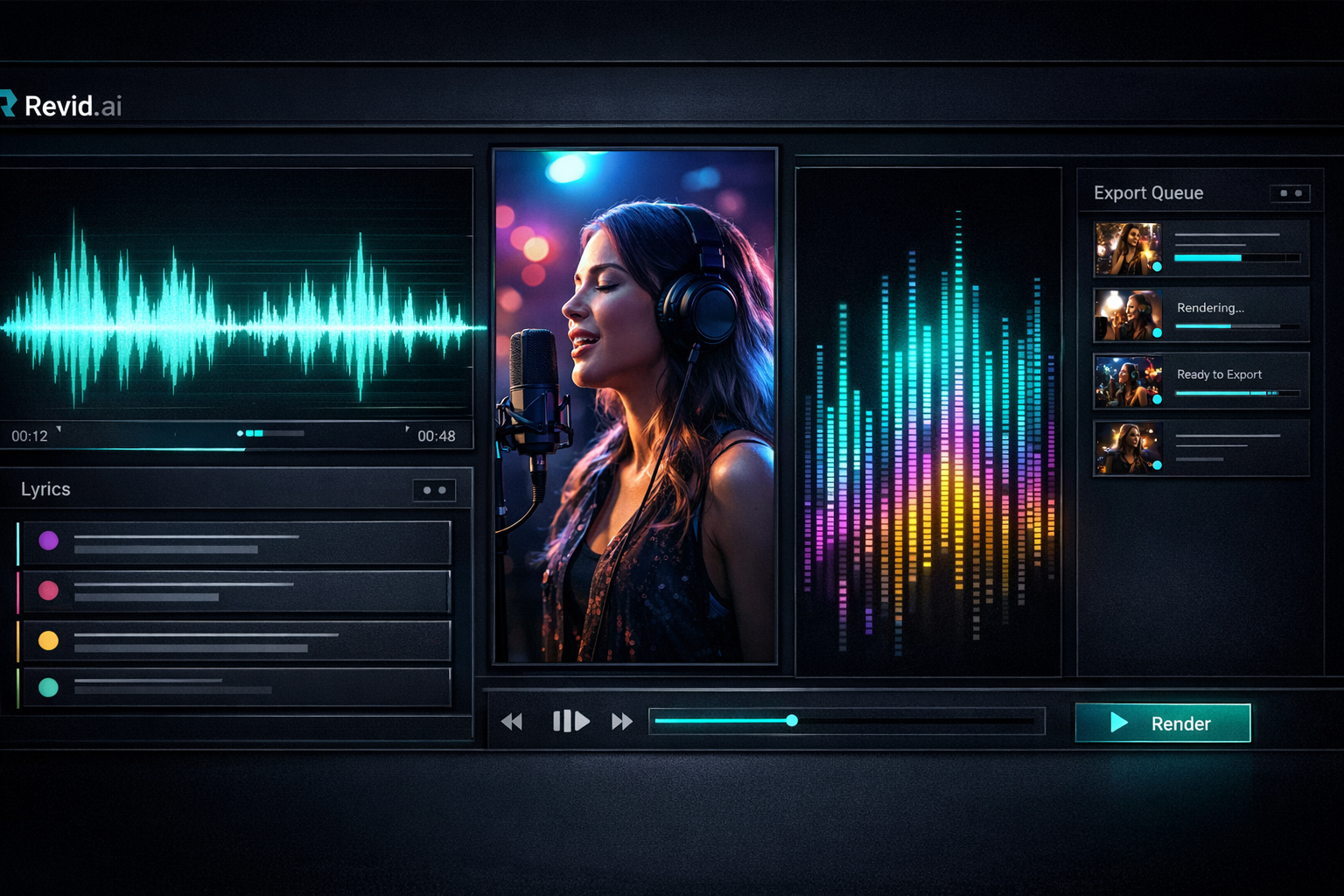
I needed a way to turn audio into something postable without opening a full edit project every time, and that is exactly where revid ai music to video earns its keep. If the track is done but the clip is not, the job is usually half creative and half cleanup. I looked at Revid.ai because it sits in that narrow space between a blank timeline and a finished promo clip. It is not trying to replace a real editor. It is trying to get you from song to usable video before you lose momentum.
That matters if you are a solo creator, a small brand, or a musician trying to push one piece of audio across TikTok, Instagram, Shorts, or a landing page. The work is not hard in theory. It is just annoying in practice. You have the sound. You need motion, timing, and something that looks intentional enough to publish. I checked the live pricing page before I went any further, because this is the kind of tool that only makes sense if it saves enough time to justify a monthly bill.
revid ai music to video is the kind of search phrase I use when I already know the problem is specific and I want the shortest path to a fix.
Quick answer:
- What the music-to-video workflow is for.
- When revid ai music to video beats a generic template.
- How to build a usable clip fast.
- What still needs manual polish.
- Revid ai music to video pricing and plan fit.
What the music-to-video workflow is for
The point of the music-to-video workflow is simple: give Revid an audio source and get back a video that feels synced instead of random. On the public pages, Revid describes this lane as music-to-video, audio-to-video, and music visualizer work. In plain terms, that means you can start with a song file or a music link and let the tool build a clip around the rhythm, pacing, and feel of the track instead of hand-building every cut.
That is why revid ai music to video works better when the audio is the lead and the visuals are there to support it.
That is the part most people miss. A generic video template starts with visuals and asks you to force audio into it. Revid flips that. It treats the audio as the lead signal. That is why this makes sense for music promos, lyric videos, short announcement clips, creator intros, and social posts where the sound matters as much as the image.
The workflow also fits the kind of jobs that do not deserve a full afternoon. If I need one clip for a release, a teaser, or a post that rides a beat drop, I do not want to source footage, match cuts, line up timing, and then export three versions because the crop is wrong. I want the audio to do the heavy lifting first.
The other thing I like here is that it does not pretend every use case is equal. This is not the right lane for a polished brand film. It is for getting a clean, usable audio-led clip out the door when speed matters more than cinematic control.
When revid ai music to video beats a generic template
A template tool is fine when the video is the main thing and the audio is just decoration. Revid makes more sense when that relationship is backwards. If the hook is in the track, the lyrics, or the beat, then the workflow should start there. That is where revid ai music to video is stronger than the usual drag-and-drop approach.
It is a better fit when you want the song to set the pace instead of forcing the song to chase the template.
The difference shows up fast. With a normal template, you spend time forcing your song to fit a structure that was built for something else. With Revid, you are closer to the actual job: make the audio feel like the reason the clip exists. That is useful for:
- song teasers
- lyric clips
- artist promo posts
- short launch announcements
- music-backed product clips
- creator intros where the sound carries the mood
If the goal is to post something fast and keep the audio synced enough that it does not feel sloppy, this is the better starting point. If the goal is total frame-by-frame control, it is not.
That is the honest split. Revid saves time when the main problem is getting from “I have the audio” to “I have something I can publish.” It does not save time if you are trying to do motion design work that belongs in a real editor.
How to build a usable clip fast
If I were using this on a normal workday, I would keep the process blunt. First, drop in the track or link. Second, pick the format you actually need, not the one that looks best in the preview. Third, choose the visual style based on where the clip is going. A vertical post for social does not need the same treatment as a square music visualizer or a widescreen embed.
This is the point where revid ai music to video saves time because it gets you a first pass without making you babysit the whole edit.
The goal is not to explore every option. The goal is to get one good pass fast.
Here is the sequence I would use:
- Start with the cleanest audio source you have.
- Choose the output aspect ratio before you touch anything else.
- Pick a visual style that matches the mood of the track instead of chasing novelty.
- Let the tool generate the first cut.
- Watch the first 10-15 seconds before you decide whether to keep it.
- Tighten any obvious mismatch in pacing or text timing.
- Export the version that is good enough to post today.
If you want to try it yourself, Revid.ai is worth testing on one real track before you decide whether it belongs in your stack.
That is the right use of a tool like this. Not endless tinkering. One real job. One real output. Then decide if it earned a place.
The first time I would use it is for a clip that needs a quick beat-driven edit without a lot of source footage. The second time is for a lyric-style post where the words matter but I do not want to build the animation myself. The third time is for a promo where I care more about finishing than perfecting. That is usually enough to tell you whether the workflow fits.
What still needs manual polish
This is where the limits show up, and I think that is useful to say out loud. Revid can get you close, but close is not always final. The parts I would still check by hand are the hook, the pacing, and anything branded. If the first three seconds feel flat, that is not a tool problem. That is a content problem. If the visual rhythm drifts from the audio, that is a quick fix before posting.
I would also keep a second editor in the stack for cleanup. CapCut, Premiere, or even Canva can still handle the things Revid should not be forced to do: final trims, custom captions, logo placement, and one-off brand touches. The point is not to make Revid do everything. The point is to make it do the part it is good at, then move on.
That matters because a lot of AI video tools fail by trying to be the whole stack. They are fine at output, but the output still needs a human pass. Revid feels more honest than that. It gives you a usable draft, not a finished creative director.
Revid ai music to video pricing and plan fit
This is the part that decides whether the tool stays in the stack or gets tested once and forgotten. Revid’s public pricing pages are a little inconsistent on naming, so I would read the numbers more than the labels. The live pricing page shows a Hobby tier at $39/month, a Growth tier with a $99 monthly price and a discounted $39/month annual option, and an Ultra tier at $199/month. The FAQ also lists Lite at $29/month for 1,500 credits, Growth at $39/month for 2,000 credits, Elite at $89/month for 5,000 credits, and Ultra at $199/month for 12,000 credits. That tells me the real conversation is about credits and output volume, not just the name of the plan.
revid ai music to video only pays off when you are shipping enough clips that the credits and time savings start to add up.
My read is simple:
- If you only need the occasional audio clip, start as low as you can and see how fast you burn credits.
- If you are making content every week, the middle tiers make more sense because you will care more about repeatable output than the headline price.
- If you are churning through a lot of music-led content for releases, launches, or client work, the higher tiers are about throughput, not vanity features.
The public pages also make it easy to start without paying first, which is the right move for this kind of tool. I am fine with paying once I know it trims enough time off a real job. I am not fine paying just because the demo looks slick.
Who should skip it
Skip Revid if you only need a basic social clip once in a while and you are already comfortable doing the edit in CapCut or Canva. It is not worth adding another subscription if your workflow is already light and you do not care about audio-led generation.
Skip it too if you want full motion control. If you are doing detailed branded motion work, complex edits, or long-form video, you are better off in Premiere or a proper editor that gives you exact control.
I would also pass if your audio is not the main event. If the video itself is carrying the message and the sound is just background, a template tool or editor may be the cleaner choice. Revid makes sense when the audio is the thing you want people to feel first.
That is why I would not call this a universal tool. It is specific. That is a good thing. Specific tools are usually the ones that stay in the stack.
Stack notes for solo creators
This is the kind of tool that fits better when you already know what happens after the clip goes live. If you are building a solo creator stack, the next question is not “can I make one video?” It is “what happens to the attention after the video gets posted?” I keep thinking about that in the same way I think about my broader creator stack, which I laid out in AI Tools for Revenue Generation: Creator Revenue Stack.
That is the right framing here. Revid does the front end of the work. It helps turn audio into something people can actually see. But the bigger system still needs a place to send the traffic, a reason to capture attention, and a next step that is not just “hope the algorithm likes it.” If you already have that part handled, this tool fits much better.
I would also use the same clip in more than one place. A music-led video is not just a social post. It can become the preview on a landing page, the opener in a newsletter, or the teaser inside a creator funnel. That is where the workflow matters after the first export in real use. If the clip is strong enough to pull attention, then the rest of the stack gets easier. You are not rebuilding the asset every time you need to reuse it.
That is the practical win for a solo operator. One audio source can become multiple outputs if the first pass is clean. I like tools that reduce the number of times I have to make the same decision. Revid does that here. It gives me one good starting point, then I can trim it, crop it, or repurpose it without starting over. That is not glamorous. It is just useful.
Final verdict
I would use revid ai music to video if I were making audio-led promo clips, lyric posts, or quick creator videos and I wanted the first pass fast. I would not use it as my main editor. That line matters. This is a workflow tool, not a full production suite.
If your job is speed, revid ai music to video fits. If your job is total control, it does not. That is the cleanest way I know to frame revid ai music to video before you spend a dollar on it.
That is the line I use most days.
If your job is to get from audio to postable video without wasting an afternoon, Revid makes sense. If your job is detailed editing, skip it and stay in your main editor.
If you want to try it yourself, Revid.ai is easy to test without a big upfront commitment.
Disclosure: I get a commission if you use my link. The price is the same either way.
About the author: Chris Myers builds AI-powered business systems and tests every tool in his own solopreneur stack before recommending it. He writes at Piscion Global.