
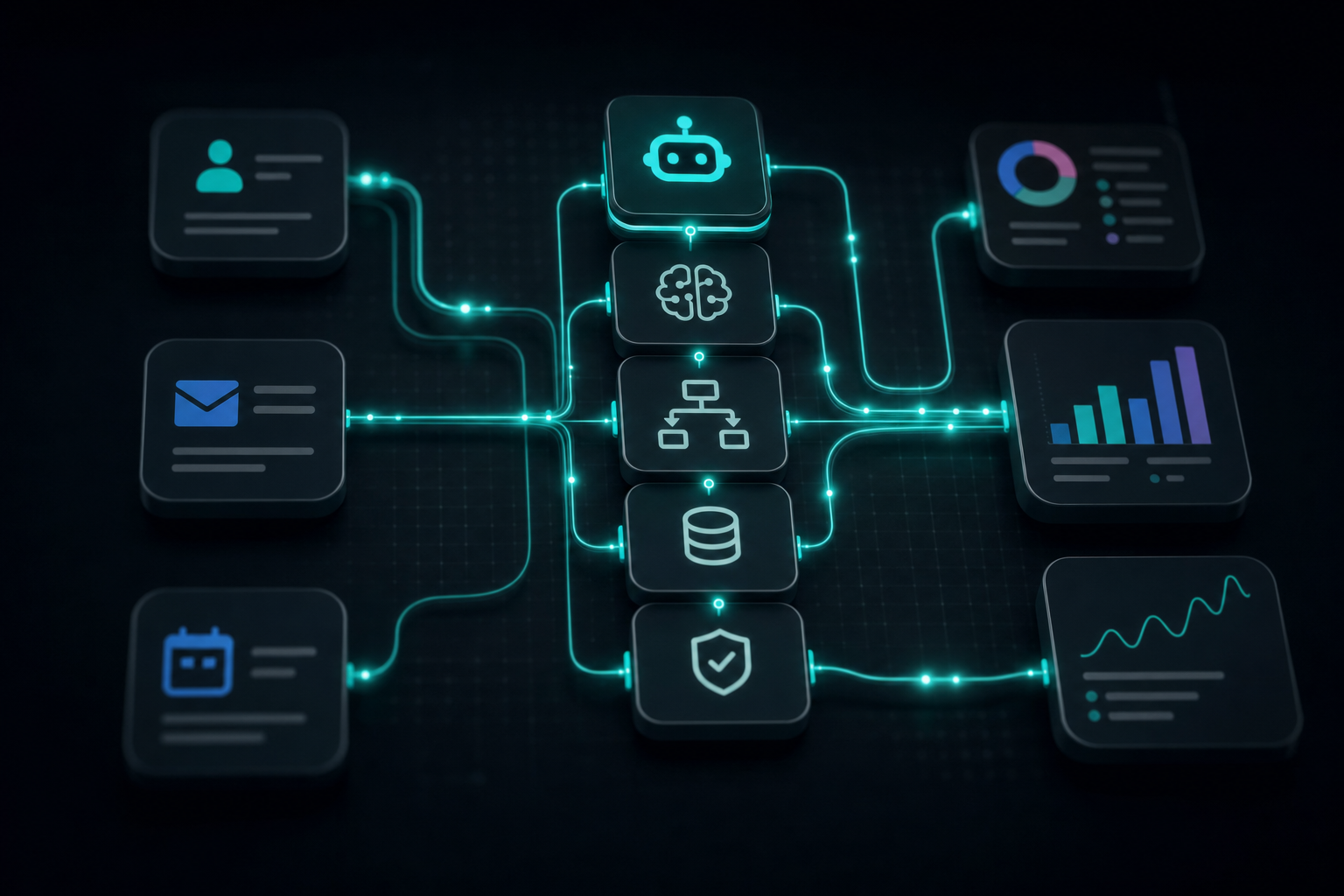
The 5 Things a Small Business Actually Needs from an AI Agent Stack
Every pitch I see for selling automation to small businesses leads with a feature list as long as your arm. Forty integrations. Voice, chat, email, SMS. A dashboard with twelve graphs. None of that is what an ai agent stack small business owners will actually keep around. I’ve built enough of these for my own work to know the difference between what demos well and what survives a month of real use. After the day job, with no team to bail me out, I only keep what earns its place. Here are the five things that actually do.
This isn’t a feature checklist. It’s the short list of requirements that decide whether the ai agent stack small business you build is still running in ninety days or quietly switched off because it caused more problems than it solved.
1. It Does One Job All the Way, Not Ten Jobs Halfway
The fastest way to lose a small business client is to sell them breadth. An owner with five employees doesn’t want an assistant that touches everything and finishes nothing. They want one painful job done completely. Lead comes in, gets qualified, gets a reply, gets logged, owner gets pinged — start to finish, no human picking up the dropped half. Pick the one job that bleeds time and own it end to end. Everything else is a distraction you’ll be supporting for free.
When I stopped trying to make a single stack do everything and started shipping one complete job at a time, the support load dropped and the results got easier to point at. That’s also the principle the Hybrid Agentic Stack Blueprint is built around — one solid backbone aimed at finishing a job, not a pile of half-wired features.
2. It Runs Without Anyone Watching It
A small business owner is not going to babysit your automation. If it needs someone to check on it, it’s not automation — it’s a part-time job you handed them. The agent stack has to run on its own schedule, recover from the small stuff on its own, and not require a human to nudge it back to life every morning. This is the bar most demos quietly fail, because a demo is someone watching the whole time.
3. It Talks to the Tools They Already Use
Nobody is switching their whole business to suit your stack. The CRM they have, the inbox they live in, the calendar they book from — your agents have to meet those where they are. Most small business work runs through a handful of ordinary tools, and connecting to them is the unglamorous part that decides whether anything you build gets adopted. Plenty of real automation gets wired up through connectors like Make rather than custom code, and that’s fine — the point is the client never has to leave the tools they trust.
The AI Agent Stack Small Business Owners Actually Use
Strip away the marketing and what’s left is plumbing. The ai agent stack small business owners keep is the boring one that quietly moves information between the tools they already have and does the one job they hired it for. The flashy parts get turned off first. I learned this the slow way, watching which pieces of my own setup I actually touched after the novelty wore off — and it was always the reliable plumbing, never the clever extras.
If you’re weighing whether one person can even deliver this kind of thing as a service, I worked through that honestly in whether a solopreneur can run an AI agent agency.
4. It Fails Loudly, Not Silently
This is the one that separates amateurs from people who’ve actually run this in production. Things break. APIs change, a credential expires, a model times out. The question isn’t whether it breaks — it’s whether you find out from your monitoring or from an angry client. A stack that fails silently is worse than no stack, because the owner thinks leads are being handled while they pile up unanswered. Build the alert before you build the feature. The stack I lean on bakes in the “tell me when it breaks” part precisely because I got burned by silent failures early.
5. One Person Can Explain It and Hand It Off
If the only person who understands the system is the one who built it, you’ve sold a hostage situation, not a service. A small business needs to be able to take it over, or hand it to someone else, without the whole thing collapsing. That means plain configuration over clever hacks, and a setup you can explain in one sitting. It’s also what makes it survivable for you as a solo operator — you can’t support what you can’t quickly re-explain to yourself six months later.
What This Means If You’re Building for Clients
The ai agent stack small business buyers actually reward is the one that nails these five. Notice what’s not on the list: no feature counts, no model names, no “powered by” badges. What a small business needs from agentic tools for clients is reliability on one job, quietly, inside the tools they already use, with a loud alarm when something’s wrong. Get those five right and the feature list takes care of itself. Get them wrong and forty integrations won’t save you.
When I’m ready to actually build one of these for a specific client, I don’t start from a blank canvas — I start from a backbone that already handles the boring five. The next post in this series walks through exactly that: building an agentic stack for a small business client from scratch.
If you want the reusable backbone I use to cover those five requirements without rebuilding from zero, that’s what the Hybrid Agentic Stack Blueprint is. The price is the same whether you use my link or go direct.
If you grab it through my link, I earn a commission at no extra cost to you, and you’re free to go direct instead. I’d rather the five things above be useful on their own — the link is just there if you want the shortcut.
Want to build one yourself?
Here are the step-by-step guides from someone who actually runs an agentic system:
Pingback: How I'd Build an Agentic Stack for a Small Business Client from Scratch