
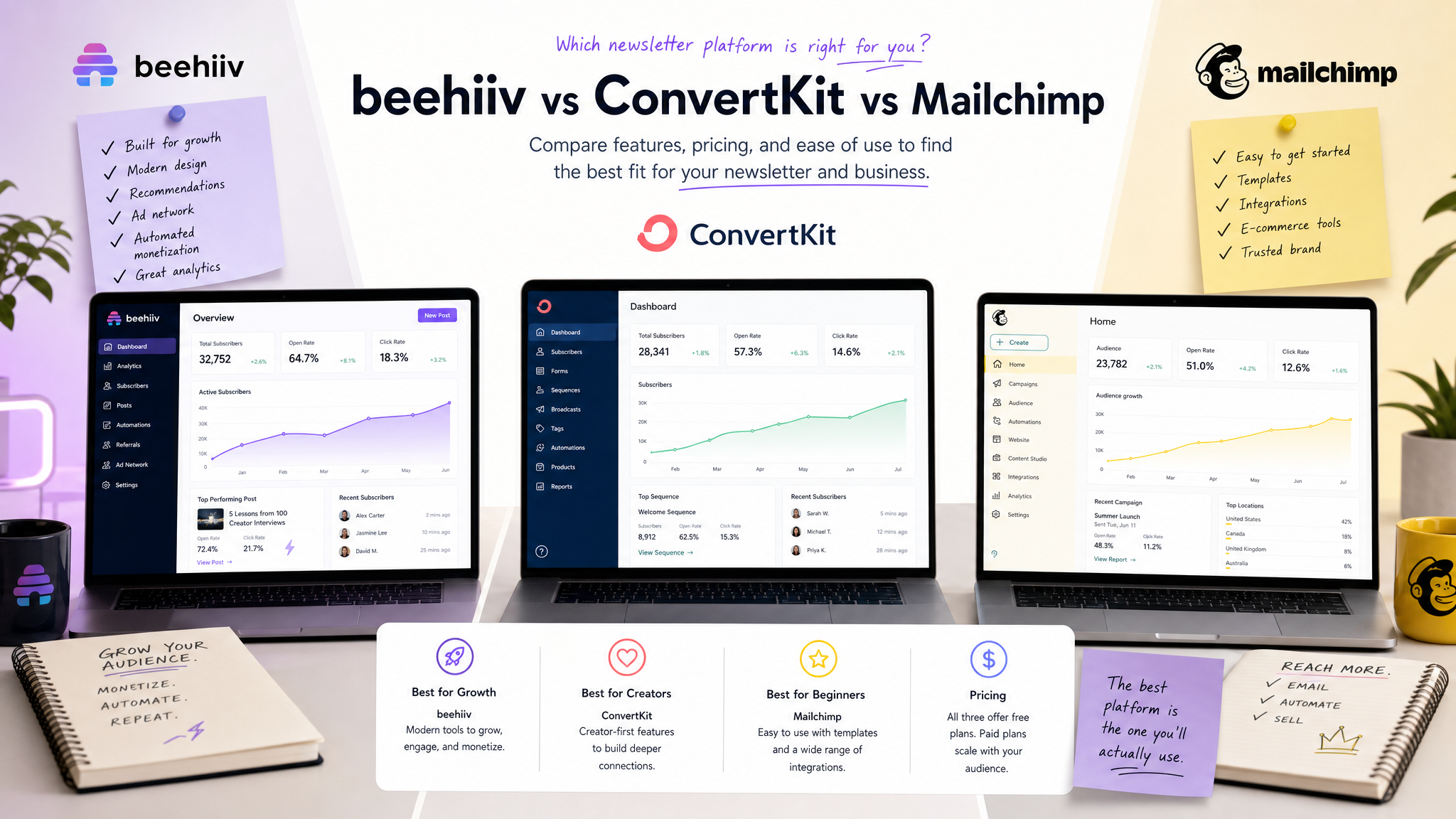
Beehiiv vs ConvertKit vs Mailchimp: The Comparison I’d Actually Use
If you’re researching beehiiv vs convertkit, this breakdown covers what actually matters for a solo operator.
I do not like comparison posts that pretend every platform is interchangeable. They are not. If you are trying to choose a newsletter tool, the wrong comparison is usually more helpful than no comparison, because it shows you what you are actually solving for.
For me, the real question is where the work lives. Do you want a lean creator newsletter tool, a classic email system, or something that sits in between? That is why I start with beehiiv and then decide whether the workflow fits better than the alternatives.
I am not going to fake precision on competitor features that change every quarter. I am going to compare the shape of the work. That is usually what matters when you are running a solo business and do not want to rebuild your stack twice.
Quick answer:
- What beehiiv is trying to solve.
- Beehiiv vs ConvertKit.
- Beehiiv vs Mailchimp.
- Where beehiiv fits best.
- Pricing and partner terms.
What beehiiv is trying to solve
beehiiv is aimed at the creator and solopreneur newsletter use case. It gives you a free starting point, a clear upgrade path, and a workflow that stays close to writing and publishing.
That is different from the old way of thinking about email marketing as a giant catch-all system. If your newsletter is part of your business model, the creator-first shape makes sense.
Beehiiv vs ConvertKit
If I am comparing beehiiv and ConvertKit, I am really comparing the feel of the workflow more than the logo on the homepage. beehiiv feels like a platform for publishing and growth around a newsletter. ConvertKit feels more like a classic creator email system.
That is not a judgment. It is a use-case question. If you already know your way around a creator email stack and you like that style, ConvertKit may still fit. If you want a simpler newsletter-first start, beehiiv is easier to explain to myself.
The biggest practical difference for me is how much I want to think about setup. Beehiiv is attractive when I want the tool to stay out of the way and let me publish. ConvertKit is attractive if I want a more familiar email-marketing mindset.
Beehiiv vs Mailchimp
Mailchimp is the comparison I use when someone wants a more traditional email platform. If your mental model is still “send campaigns to a list,” Mailchimp feels closer to that world.
Beehiiv feels more like a newsletter operating system. That matters if you care about creator-style publishing, audience growth, and a simpler solo workflow. If you mainly want a broad email tool and you already know how you work, Mailchimp may be enough.
Beehiiv Vs Convertkit is worth understanding before you commit to any newsletter stack.
I would not pick one based on brand familiarity alone. I would pick the one that matches the job. If you are building a newsletter as part of a business, the workflow matters more than habit.
Where beehiiv fits best
Beehiiv fits best when you want a lean start, a free plan, and a platform that does not feel like a giant marketing maze. It also fits if you do not want to pay too early while you are still proving whether the list is real.
That is where the price point matters. The official pricing page is here: https://www.beehiiv.com/pricing. beehiiv has a free plan, and paid plans start at $49 per month.
The comparison only gets clearer when you ask what you want to optimize for:
– keep costs low while the list is small
– reduce setup friction
– stay focused on writing and publishing
– avoid a stack that feels like admin work
For a solo newsletter operator, beehiiv vs convertkit is the question worth spending time on before you pick a platform.
Pricing and partner terms
The partner page is here: https://www.beehiiv.com/partners. The verified current terms are simple: the partner program advertises up to 60% commissions for 12 months, with monthly payouts via PayPal around the 15th.
That matters if you write about the platform, but it should not be the reason to choose it. I would still make the decision based on fit first.
My pick by scenario
If I need the shortest path to a newsletter that feels light, I would start with beehiiv.
If I wanted a classic email-marketing setup and already had a system I trusted, I would not switch just for the sake of switching.
If I was building from zero and wanted a tool that could grow with me without a heavy start, beehiiv is the one I would test first.
The decision tree I would actually use
If I were choosing for real, I would not start with the feature list. I would start with the stage of the business.
That is one reason beehiiv vs convertkit keeps coming up in these conversations.
If the list is still small and the goal is simply to get consistent sends out the door, beehiiv makes the most sense because the free plan lowers the cost of starting. If the newsletter is already central to the business and I care more about publishing rhythm than marketing complexity, beehiiv still stays in the conversation.
If I needed a more traditional email environment and already had muscle memory around that kind of tool, I would compare beehiiv carefully against what I already know. I would not switch just because a tool looks modern. Switching has a cost too.
If I was somewhere in the middle, I would ask three questions:
– Do I need the newsletter to feel lighter to run?
– Do I want to avoid paying early while I am still proving the audience?
– Do I care more about a creator-style workflow than a classic campaign builder?
Those are the questions that matter to me because they decide whether a tool stays useful after the first month. The homepage never tells you that part.
I would also be honest about the limits of the comparison. I am not trying to crown a universal winner. I am trying to find the least annoying tool for a solo workflow. That is a smaller question, but it is the one that actually gets used.
For beehiiv specifically, the free plan and the $49/month starting point make the tradeoff easy to understand. The platform either saves me enough time and friction to justify the move, or it does not. There is not much mystery in that.
What I would compare in a real test
If I were comparing beehiiv against ConvertKit and Mailchimp in the real world, I would not start by counting features. I would start by asking which tool makes my life easier on a busy week.
Most people searching beehiiv vs convertkit are trying to avoid a platform switch six months down the road.
The easiest way to see that is to run a small test. Write one issue, send one issue, and then repeat the same process a week later. The platform that still feels reasonable after the second run is usually the one that wins. I care about repeatability more than novelty.
I would also compare the amount of thinking each tool asks for. Some tools make me think about tags, segments, automations, and setup paths right away. Others let me publish first and figure out the rest later. For a solo operator, that difference matters a lot.
That is where beehiiv earns its place in the discussion. The free plan lowers the cost of testing, and the workflow keeps the newsletter close to the writing. If I am trying to build a publishing habit instead of a complicated system, that is a good fit.
For a solo operator, beehiiv vs convertkit is the comparison that tends to matter most.
I would still be honest about the tradeoff. If I already had a working tool and I was comfortable with it, switching just because beehiiv looks cleaner would not be a good decision. The cost of moving is real. The old system only looks bad when the new one is already in front of me.
So my real advice is this: use the comparison to reduce confusion, not to create a new round of indecision. Pick the platform that makes the next month easier to run.
That is usually the one I keep.
One more practical note: I would not use a comparison like this to chase perfection. The goal is not to prove one tool is flawless. The goal is to pick the tool that lets me publish without fighting my own setup.
That sounds obvious, but it is easy to forget when you are reading reviews. A lot of comparison posts create the feeling that the perfect choice is hidden one paragraph away. In real life, the better choice is usually the one that fits the work you already know you need to do.
If beehiiv gives me a cleaner start, lower pressure, and a more obvious path from first issue to paid plan, that is enough to justify testing it. I do not need it to beat every platform in every category. I just need it to make sense for the lane I am actually in.
That keeps the decision honest.
That is all I need from the comparison.
If you want to try it yourself, beehiiv’s free plan covers up to 2,500 subscribers — plenty of runway before you pay anything.
For the full breakdown on beehiiv pricing and what the partner program actually pays, here is the cost-value breakdown.
Disclosure: If you use my link, I do get a commission. The price is the same to you whether you use my link or go direct.
About the author: Chris Myers builds AI-powered business systems and tests every tool in his own solopreneur stack before recommending it. He writes at Piscion Global.
Pingback: beehiiv Pricing: Is It Worth It? A 5-Point Cost Breakdown