
90-Day Fitness Plan Template: The System That Keeps You Accountable
A 90 day fitness plan template works when it makes you check in every week, track your numbers, and stop guessing. I built the 90 day fitness plan template behind my tools hub the same way I build every useful system: make the goal visible, make the follow-through annoying to ignore, and keep the plan simple enough to keep using.
Last updated: 2026-08-09
The problem is not that people do not know how to work out. The problem is that most plans do not help you stay honest long enough to see change. That is why I treat this more like a scorecard than a workout list.
Quick answer:
- A 90 day fitness plan template should tell you what to do, what to track, and when to adjust.
- Weekly check-ins matter more than perfect motivation.
- Progressive overload only works if you write it down.
- A nutrition companion keeps the plan from falling apart between workouts.
- This is the structure behind the Budget Tracker Kit and every other scorecard I build: one clear plan, one clear review loop.
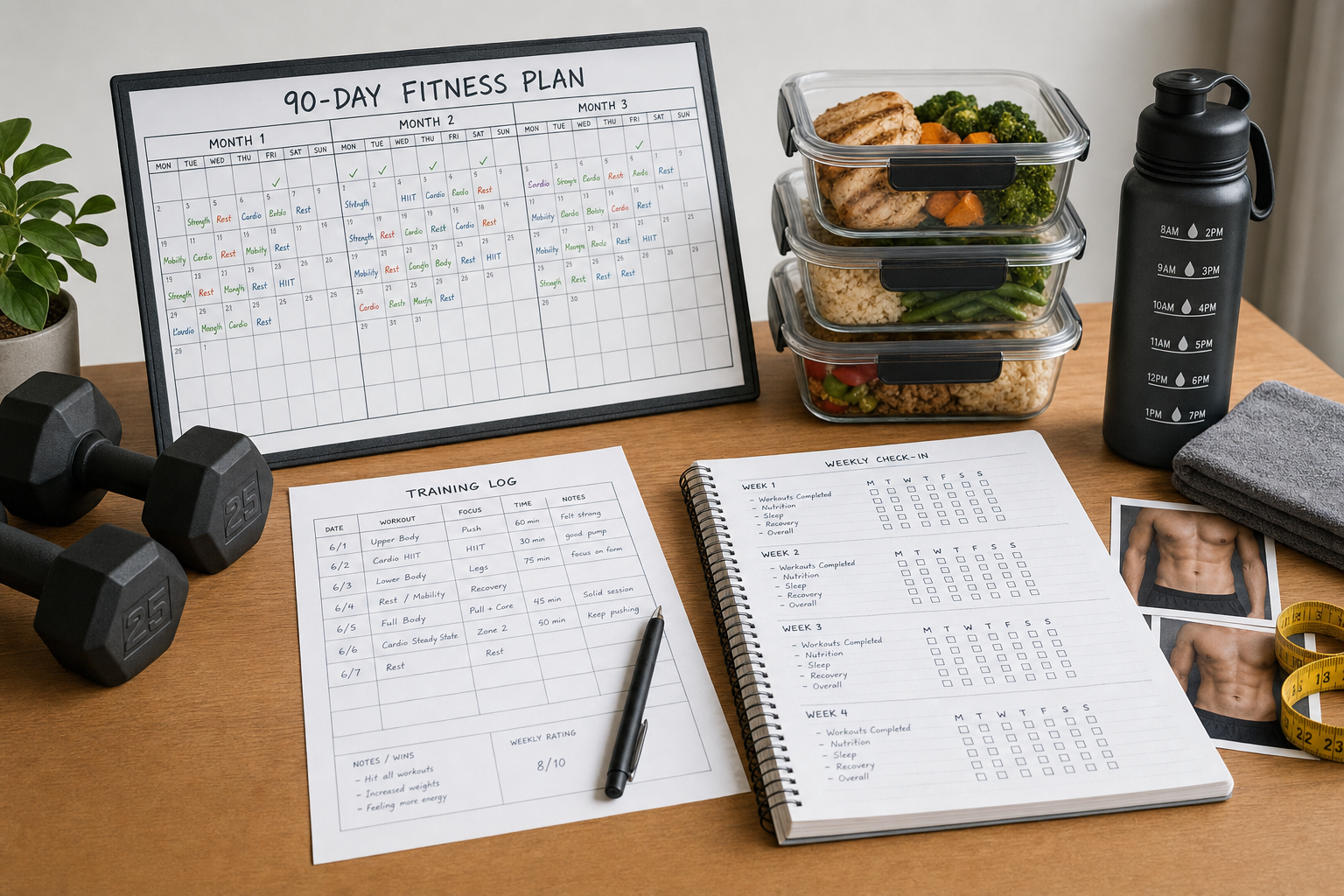
What does a 90 day fitness plan template actually need?
A 90 day fitness plan template is a guided system that turns training into weekly decisions instead of a vague promise. The template does not need to be fancy. It needs to show you the starting point, the weekly target, the progress check, and the adjustment you make when life gets messy.
For me, that means four things show up every time:
| Part | What it does | Why it matters |
|---|---|---|
| Workout schedule | Shows which days you train | Removes decision fatigue |
| Progress tracker | Logs weight, reps, or cardio time | Makes small improvements visible |
| Weekly check-in | Reviews what happened | Keeps you from drifting |
| Nutrition companion | Tracks meals or habits | Stops the plan from dying outside the gym |
I have tested enough systems to know this: the plan itself is not the hard part. The hard part is whether you can see what is happening before week six turns into week twelve with no progress to show for it. That is where the accountability loop earns its keep.
If you want a cleaner way to think about it, the Personal Cash Flow System works the same way. You do not improve what you do not track. Fitness is no different.
How to create a 90 day fitness plan?
How to create a 90 day fitness plan starts with building a plan you can review, not one you can admire. The best 90 day fitness plan template is the one that gives you a clear path from baseline to finish line without pretending every week will go perfectly.
- Pick your goal. Choose one main outcome: fat loss, strength, endurance, or a simple habit reset.
- Set your weekly schedule. Decide how many days you will train and which days are non-negotiable.
- Record the baseline. Write down body weight, waist, photos, and your starting lifts or cardio numbers.
- Build the first 30 days. Keep the workouts simple enough that you can repeat them without needing a new plan every session.
- Increase the workload in days 31-60. Add a little more weight, a few more reps, or a small amount of time.
- Tighten the plan in days 61-90. Keep the parts that worked and remove the noise.
- Run a weekly check-in. Use the same day each week to update your numbers and make one decision for the next week.
That is the whole model. You are not trying to become a new person in one day. You are trying to make the next 90 days more honest than the last 90 days.
The Budget Tracker Kit on this site is built around the same idea. A recurring review loop is what keeps a plan alive.
What should a beginner workout plan include?
A beginner workout plan should include a repeatable schedule, basic movement patterns, room for recovery, and a way to measure whether the work is actually happening. Beginners do not need a complicated split. They need a plan they can survive long enough to improve on.
Here is the baseline I would use for a beginner inside a 90 day fitness plan template:
- 2-4 training days per week. Enough to create momentum without burning out.
- Push, pull, squat, hinge, carry, and core work. The basics still work.
- One or two cardio sessions. Keep it simple and consistent.
- Rest days. Recovery is part of the plan, not a bonus.
- Simple progression. Add reps first, then load, then volume if needed.
If you want a practical reference for general movement basics, the CDC’s physical activity basics page is a solid external check on the minimums and the why behind them. I like that better than pretending every beginner needs a different secret formula.
The beginner trap is overcomplicating the first two weeks. I would rather see someone do the same simple plan for 12 weeks than bounce between five workout styles because the internet made consistency feel boring.
How to track fitness progress?
How to track fitness progress is mostly about picking a few numbers and using them every week. The best fitness transformation tracker is boring on purpose. If the tracker is too clever, people stop using it.
I track five things in every good plan:
| Metric | Why it helps | When to review |
|---|---|---|
| Body weight | Shows the trend | Weekly |
| Waist or measurements | Catches changes the scale misses | Every 2 weeks |
| Progress photos | Shows visible change | Every 2 weeks |
| Workout log | Proves overload is happening | Every session |
| Nutrition score | Shows whether the plan is supported outside the gym | Weekly |
This is where accountability matters more than motivation. If the numbers are visible, you can make clean decisions. If they are not, you start telling yourself the plan is working because you feel busy.
I built the 90-Day Fitness Transformation Kit around that exact problem. It is not just a workout planner template. It is a fitness transformation tracker with a weekly review loop and a nutrition companion so the whole thing stays connected.
If you want the same mindset in another lane, the Personal Cash Flow System shows why scorekeeping beats guesswork. Different topic, same lesson.
Is 90 days enough to see results?
Yes, 90 days is enough to see results if the plan is consistent and the tracking is real. The size of the result depends on the starting point, the weekly effort, and whether you keep adjusting the plan when the numbers stall.
For most beginners, 90 days is long enough to see at least one of these happen:
- Strength goes up.
- Energy gets more stable.
- The scale moves in the right direction.
- Clothes fit differently.
- The habit stops feeling new.
What 90 days is not is magic. If the plan has no check-in, no progressive overload, and no nutrition support, the calendar by itself will not save it. I have seen that enough times to stop pretending otherwise.
That is why the plan has phases. The first phase builds the habit. The second phase proves the habit can handle more work. The third phase shows whether the whole system is actually changing anything.
What the 90-day phases should look like
The 90 day fitness plan template works best when it moves through three simple phases. Each phase has a different job.
| Phase | Focus | What you track | What usually breaks |
|---|---|---|---|
| Days 1-30 | Consistency and baseline | Attendance, starting numbers, meal pattern | Overthinking and skipping the log |
| Days 31-60 | Progressive overload | Reps, load, cardio time, weekly check-ins | Trying to change too much at once |
| Days 61-90 | Tightening and review | Photos, measurements, strength trend, recovery | Getting sloppy because the end is near |
I like this structure because it gives the plan a job at each stage. The plan is not just “do workouts.” It is “build, progress, review.” That is a much better fit for people who need accountability to stay in the game.
If you are the kind of person who only uses a plan when it stays visible, you will probably also like the way I build systems around repetition in the tools hub. The same principle applies: fewer moving parts, more follow-through.
What I would put in the nutrition companion
The nutrition companion does not need to be a full diet plan. It needs to stop the classic split where training is serious and meals are random.
At minimum, I would track:
- Protein at each meal.
- Water intake.
- One or two repeatable breakfast options.
- Meal prep for the busiest days.
- A simple weekend review of what was missed.
That is enough to keep the plan grounded. A lot of people want a 90 day fitness plan template that tells them exactly what to eat every day. Most of them do better with a lighter structure they can actually follow.
If I were making this from scratch, I would pair the workout template with a simple meal prep companion and keep both on the same weekly check-in sheet. That is how you make the system support itself instead of making one part of it fight the other.
About the author: Chris Myers builds AI-powered business systems and tests every tool in his own stack before recommending it. He writes at Piscion Global.
If you want the shortcut, I built the 90-Day Fitness Transformation Kit for this exact use case. It gives you the template, the tracker, and the accountability structure without making you build it from scratch.
That is the simplest answer: use a 90 day fitness plan template that makes weekly review unavoidable. If the plan does not make you honest, it will not make you better.