
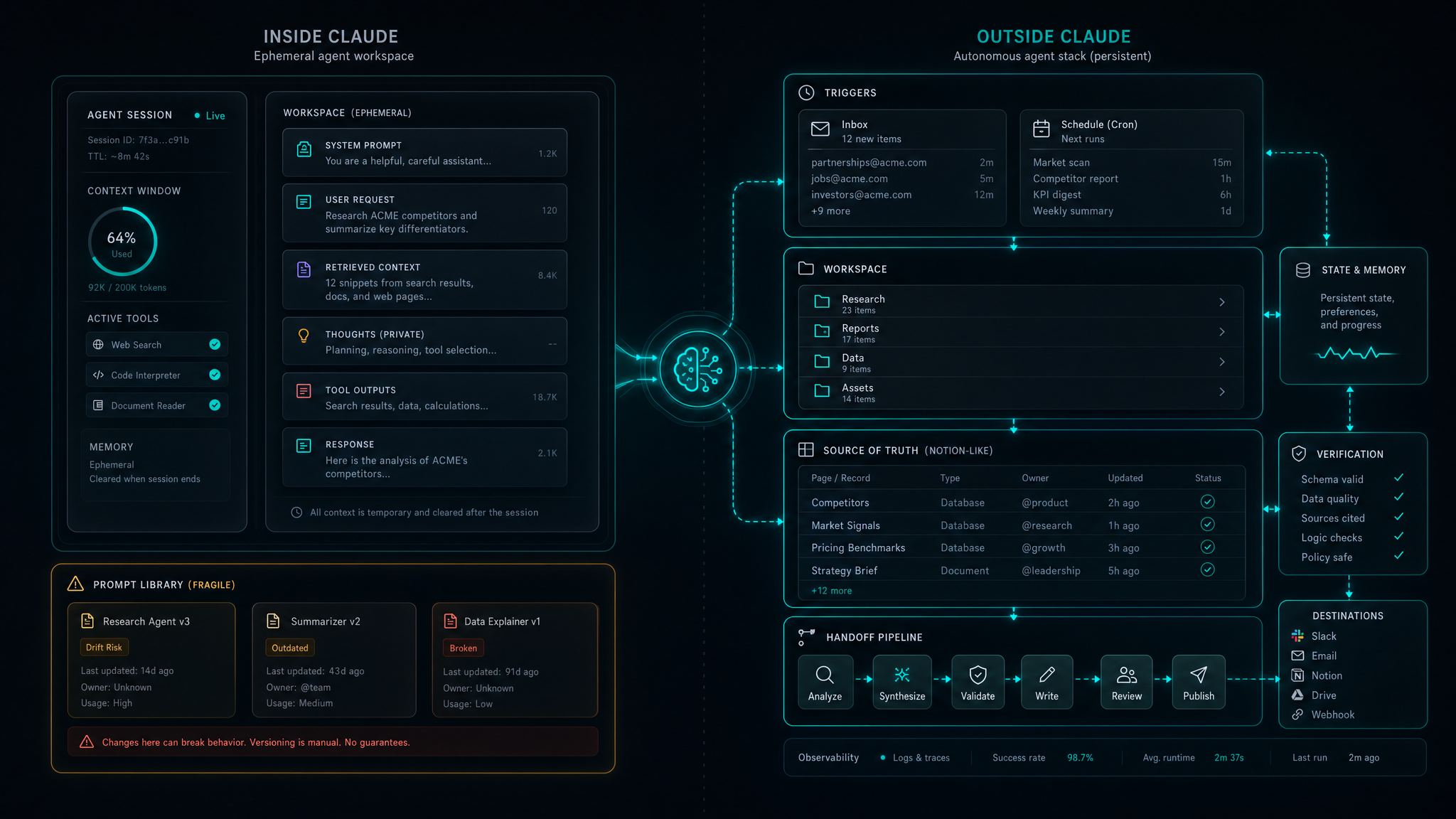
AI Agents Inside Claude vs Autonomous Agents: Why the Architecture Matters
If you are comparing ai agents inside claude vs autonomous agents, the real question is not which model is smarter. It is where the work lives after the prompt. A prompt library can help you move faster inside one session. A real agent stack keeps state, survives between sessions, and still works when you are not staring at the screen. That is the split between ai agents inside claude vs autonomous agents.
That is why The Agency caught attention. It gives people a huge menu of specialized agents they can load into Claude Code and other tools. The repository behind it is popular for a reason. It is useful, and for a lot of one-off jobs it is enough. But there is a difference between a strong prompt pack and a stack that actually behaves like infrastructure.
The line from a breakdown I watched stuck with me: “232 agents is overwhelming. Most people install all of them, get paralyzed, and use none.” That is the problem in one sentence. Too many builders confuse a long list of prompts with an operating system for work.
Quick answer:
- What ai agents inside Claude vs autonomous agents actually means.
- Why The Agency works for a lot of people.
- The ceiling on context-bound agents.
- What a real agent stack looks like.
- Why I keep OpenClaw outside the model.
What ai agents inside Claude vs autonomous agents actually means
The easiest way to think about it is this: agents inside Claude live inside the model’s context window. Autonomous agents live outside the model and call the model when they need reasoning. That sounds subtle until you build with both.
Inside Claude, the agent is usually a prompt, a system instruction, or a subagent file. It can be powerful. It can also be fragile. When the session ends, the context ends. When the prompt is not loaded, the agent disappears. When the user has to keep re-pasting the same setup, the user is the bottleneck.
Autonomous agents are different. They persist as processes, services, scheduled jobs, inbox watchers, database rows, or workspaces with memory. The model is still important, but it is a worker in the loop, not the place where the whole system lives.
That difference matters because most solo operators do not need more clever prompts. They need work that survives interruption. They need the system to remember where it was, what happened, and what comes next.
Why The Agency works for a lot of people
I want to be fair here. The Agency is not nonsense. It is a clean example of what happens when people package specialist roles into a format that is easy to install and easy to understand. For builders who want to experiment fast, that matters.
It also lowers the barrier to entry. You can grab a role, try it in your workflow, and see whether it earns its keep. That is useful when you are just figuring out what kind of help you actually want from an agent.
The problem starts when people treat that install as the finish line. If the whole system is still living inside Claude, then every job still depends on session state, prompt quality, and the user staying in the loop. That is fine for a lot of tasks. It is not the same thing as autonomy.
So yes, I would credit The Agency fairly. It is a strong prompt library. It is a smart way to package roles. I just would not confuse that with a persistent AI agent stack. That is the practical limit of ai agents inside claude vs autonomous agents.
If you want the repo itself, The Agency lives at msitarzewski/agency-agents on GitHub.
The ceiling on context-bound agents
Context-bound agents break down in predictable ways.
- They forget the state of the last run.
- They rely on the user to reintroduce the problem every time.
- They do not naturally keep an inbox, queue, or cron.
- They are great at answering, less great at continuing.
That last one is the real issue. An AI that answers well is useful. An AI that can continue work without being babysat is a different category.
That is why a prompt library can feel impressive while still leaving the actual operator to do the glue work. If you have to hold the process together by hand, the process is not autonomous. It is assisted.
This is also where people overestimate the model and underestimate the architecture. The model is not the whole product. The architecture is the product. In ai agents inside claude vs autonomous agents, the system wins.
What a real agent stack looks like
A real stack has persistence. It has places for work to land. It has clear state. It has a way to wake up again tomorrow and know what it was doing yesterday.
For me, that means things like:
- inboxes for incoming work
- workspaces where files and notes live
- crons or scheduled checks
- vaults or databases as source of truth
- handoffs that survive a session ending
That is the difference between an agent that looks smart and an agent that can run a job. The model gets called when there is work to do. The model does not own the entire operating environment.
I wrote about this same distinction in OpenClaw autonomy. That post is the cleaner version of the argument: the orchestration layer matters more than the worker.
It also lines up with how to build an AI agent system. If the job, input, boundary, and handoff are sloppy, the model just becomes a faster way to make messy output.
Why I keep OpenClaw outside the model
OpenClaw is built around that separation on purpose. The agents live outside the model. The model is called when there is actual work. That means the workflow can keep moving even if the model changes, the interface changes, or the session disappears.
That is what I want as a solo operator. I do not want my whole workflow trapped inside one chat window. I want durable processes. I want intake, routing, verification, and handoff to survive between runs. I want state to live somewhere real.
That is also why I care about Notion as source of truth, workspaces for file state, and inboxes that can hold unfinished jobs. Those are not fancy features. They are the difference between a stack and a demo.
In this setup, the model is a reasoning layer. It is good at deciding, rewriting, and checking. It is not the vessel. The vessel is the system around it.
Claude Code is still a good worker
I do not think Claude Code is the wrong tool. I think it is the wrong thing to confuse with the whole system.
Claude Code is useful when the work is close to the codebase, close to the terminal, and close to the files. Anthropic’s own docs position it as a terminal-based coding agent that can edit files and run tests, which is exactly what I want from a worker in the stack.
That is fine. I want workers. I just do not want to confuse workers with the machine that coordinates them.
When Claude Code is the worker, it can be excellent. When Claude Code becomes the whole architecture, the user is still doing the real orchestration. That is the part that wears you out over time.
Who each approach is for
The Agency makes sense if you want a fast install, a lot of roles, and a simple way to test what specialized prompts can do for you. If you are experimenting, that is a solid starting point.
Autonomous agents make more sense if you are trying to build a repeatable operation. That is the lane I care about. I want systems that keep working when I am busy, not systems that only work when I am sitting there feeding them context.
So the honest answer is not that one is better in every case. It is that they solve different problems. Prompt libraries help you start. Autonomous stacks help you keep going.
The part I would build next
If I were building from scratch today, I would not start by chasing more agents. I would start by defining the control plane. What is the intake? Where does state live? What wakes the system up? What gets checked before anything moves forward?
Then I would add workers where they fit. Claude Code can be one of them. Codex can be another. The Agency can be a prompt source. But none of those should own the architecture.
That is where the next step is headed for me: Codex Autobuilder. If I want a real autonomous stack, I want a system that can assemble, route, and verify work without turning every job into a manual setup session. That is the point of ai agents inside claude vs autonomous agents.
That is the line I keep coming back to. A prompt library is a useful starting point. A persistent stack is the thing that makes the workflow durable.
And that is the actual answer to ai agents inside claude vs autonomous agents: one lives in the session, the other lives in the system.
One thing most builders skip: before you wire agents together or hand them real traffic, you need a cost model. API calls compound fast once a workflow is running — retries, context overhead, multi-step pipelines, and parallel agents all add up in ways a single test run won’t show you.
If you’re new to this, start here: LLM Cost Control: Set This Up Before You Build an AI Agent System. The post covers all three stages — planning before launch, managing costs across a multi-agent stack, and monitoring at scale. If you want a hands-on tool, the LLM Cost Control Starter App is $10 on Gumroad. It’s a client-side planner for routing, estimating, and keeping spend proportional to what the system actually produces.
The bottom line
The Agency is fine when you want a prompt library and a quick way to experiment. I would use it for that. I would not stop there.
If the goal is a system that keeps state, survives sessions, and keeps moving while you are doing something else, then you need an autonomous stack outside the model. That is where OpenClaw fits. That is where the architecture starts to matter more than the prompt.
And that is the difference I care about: not more agents, but a better place for them to live. That is the cleanest answer to ai agents inside claude vs autonomous agents.
About the author: Chris Myers builds AI-powered business systems and tests every tool in his own solopreneur stack before recommending it. He writes at Piscion Global.
Pingback: AI Agent Build Blueprint for Reliable Workflows
Pingback: Hybrid Agentic Stack Blueprint for AI Operators
Pingback: LLM Cost Control: What I Track Before Scaling AI
Pingback: AI Agent for Customer Support: What It Changes