
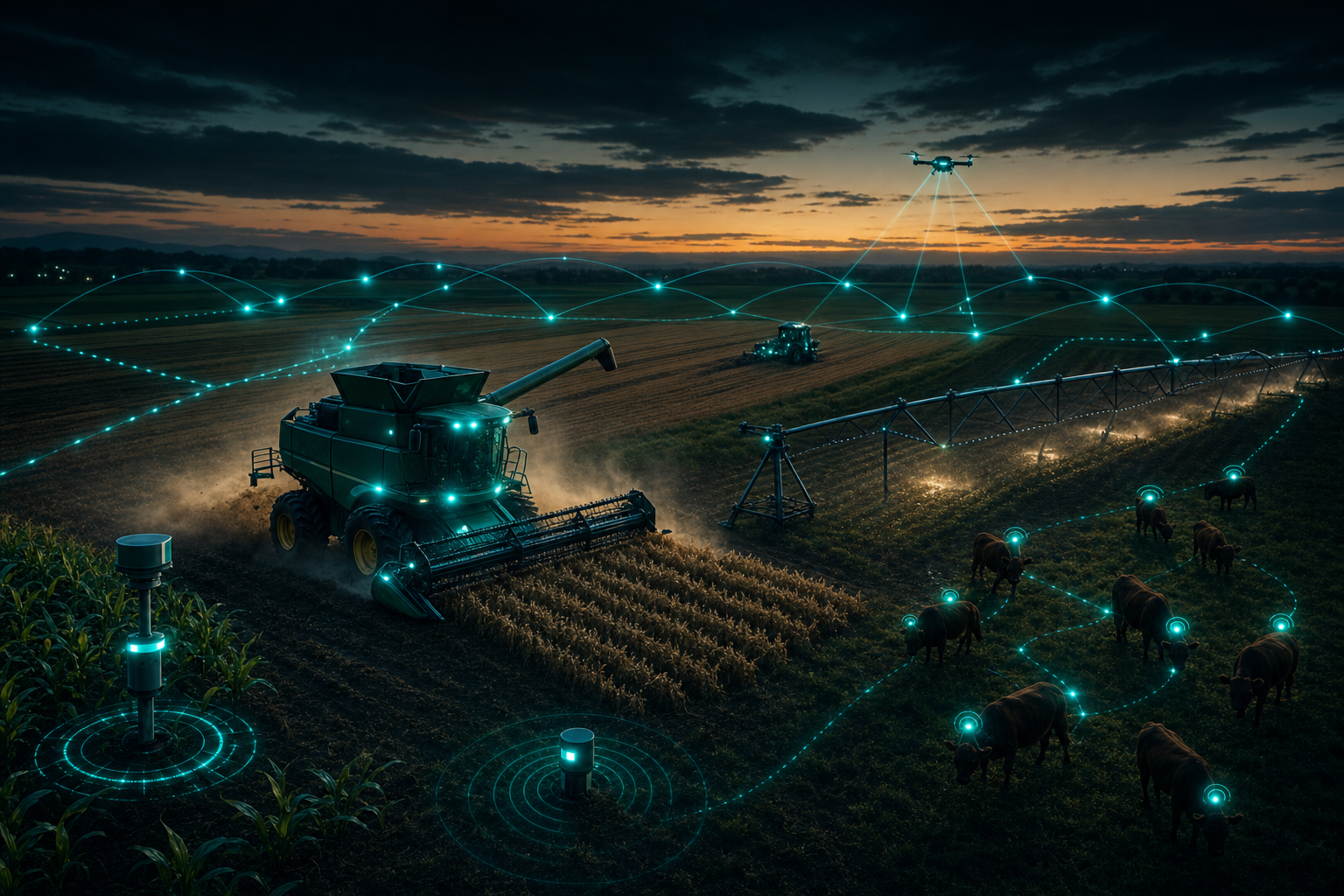
AI in Agriculture: Practical Systems That Help Farmers Reduce Labor, Waste, and Risk
AI in agriculture is most useful when it helps farmers see trouble sooner, compare options, and coordinate work without taking control away from the people responsible for the land, livestock, equipment, and business. The practical test is simple: does the system improve a farm decision while leaving the farmer able to question, override, repair, and leave it?
That is a narrower claim than the usual pitch about autonomous farms. It is also more useful. I build AI-powered business systems, but I do not run a farm. So I approached this as an evidence review, using federal research, land-grant Extension material, and farm-technology policy work instead of pretending that software experience makes me an agronomist. The same control principle I use when evaluating AI systems for small businesses matters even more when a bad output can waste water, miss a disease signal, sideline a machine, or affect animal care.
Quick answer
- Guidance, mapping, variable-rate application, sensors, and automated controls are established parts of precision agriculture. They are not automatically AI.
- AI enters when a system uses data to detect patterns, predict an outcome, prioritize attention, or coordinate a response.
- The best fit depends on farm scale, the bottleneck being solved, local support, connectivity, and whether the farmer can export data and override the system.
- Costs, repair access, cybersecurity, false alerts, missed detections, and vendor lock-in belong in the buying decision from the start.
- A pilot should be judged against a farm-specific baseline. Savings measured on one crop, field, herd, year, or study should not be treated as a promise for another farm.
What counts as AI in agriculture?
Precision agriculture is the broader operating system. It includes GPS guidance, yield maps, soil maps, variable-rate application, weather stations, livestock sensors, section control, and machine telemetry. Automation performs a defined action, such as steering along a path, opening an irrigation valve, or dispensing a ration. AI is the part that infers something from data: a likely disease signal, a yield forecast, an unusual pressure reading, an animal that needs attention, or a dispatch plan for several machines.
The distinction matters because mature tools and experimental models should not be evaluated the same way.
| System type | What it receives | What it does | Where farmer judgment stays involved |
|---|---|---|---|
| Precision sensing and mapping | Moisture readings, soil tests, position, yield, weather | Records field or herd conditions | Decides whether the data are reliable and what action fits local conditions |
| Rule-based automation | Set points, routes, schedules, thresholds | Repeats a defined task | Sets limits, handles exceptions, and stops unsafe operation |
| AI detection or prediction | Images, sensor history, weather, field records | Flags patterns or forecasts an outcome | Checks false positives, false negatives, uncertainty, and consequences |
| AI coordination | Machine location, capacity, workload, maintenance, timing | Prioritizes people, equipment, or tasks | Approves the plan, resolves tradeoffs, and retains override authority |
This is why “AI farming” can be a misleading label. A soil-moisture probe is a sensor. A GPS steering system is automation. A model that combines moisture, soil, crop stage, and weather to predict stress is closer to AI. A good farm stack may use all three, but the label should describe the work being done rather than decorate every connected device.
Where can AI help farmers today?
The strongest use cases reduce the time spent looking for a problem, improve timing, or make a complicated operation easier to coordinate. They support a person who knows the farm. They do not remove the need for agronomy, husbandry, repair skill, or local knowledge.
Soil, moisture, and nutrient decisions
Soil and crop systems can combine field sensors, satellite or drone imagery, yield history, and weather data to show where conditions differ. The useful output may be a scouting priority, an irrigation alert, or a zone map for variable-rate application.
This is often described as AI even when the main value comes from accurate sensing and mapping. The model becomes important when it predicts stress or recommends where to look next. That recommendation is only as dependable as the sensor placement, calibration, weather exposure, labels, and field history behind it. Clemson Extension warns that humidity, heat, dust, debris, oxidation, and storms can degrade agricultural sensors and produce bad readings.
A moisture value is not an agronomic prescription by itself. The farmer or adviser still has to account for crop stage, rooting depth, soil texture, recent irrigation, and the cost of being wrong.
Local weather, irrigation, and water distribution
Farm-level weather stations, soil-water measurements, evapotranspiration estimates, and forecasts can improve the timing of irrigation, frost response, planting, spraying, and harvest. USDA Climate Hubs lists field-level decision tools built around local weather and climate data. The U.S. Government Accountability Office also describes soil-moisture sensing, satellite data, and variable-rate systems that can support irrigation decisions and find problems such as blocked nozzles.
That does not support one water-savings percentage for every farm. Applied-water changes depend on the old system, soil, crop, weather, pressure, distribution uniformity, and whether water not applied in one place is conserved or used elsewhere. A model can help decide when and where to water. It cannot make those physical and economic differences disappear.
Pest and disease detection
Cameras and other sensors can scan plants, stored grain, or animals for patterns that deserve attention. The most defensible use is triage: send a person to the right row, bin, pen, or animal sooner.
USDA Agricultural Research Service reports at least 96% identification accuracy for five stored-grain insect species in one image-based system. That is a classification result for five species. It is not proof that AI cuts pesticide use, losses, or mortality by 96%.
The operating questions are less flashy and more important. What happens when the camera is dirty? Which pests or diseases were absent from the training data? How expensive is a missed detection? Does an alert trigger treatment automatically, or does a person inspect first? High-consequence actions involving chemicals, culling, or animal treatment need bounded rules and human approval.
Crop rotation, planning, and yield forecasts
AI can pull field histories, soil tests, pest pressure, weather scenarios, equipment constraints, input prices, and expected yields into one planning view. It can compare scenarios and flag conflicts that are easy to miss across many fields.
That is decision support. The evidence reviewed for this article does not show that a general AI system can choose the best crop rotation across farms. Rotation also depends on disease cycles, soil health, contracts, feed needs, labor, equipment, and cash flow. Those are farm and business judgments.
Yield forecasting has a clearer role. Models can combine weather, soil, remote sensing, management records, and historical yields to update harvest, storage, feed, contracting, and staffing plans. UF/IFAS Extension describes promising work across several crops while stressing that the output is only as good as the data. A useful forecast should name the crop, geography, time horizon, validation method, and uncertainty range. One accuracy number across systems would hide more than it explains.
Machinery dispatch, maintenance, fuel, and harvest logistics
Large field operations create a coordination problem. Combines, grain carts, trucks, operators, storage, fuel, and maintenance all have to meet at the right time. Sensors and machine records can show location, capacity, engine hours, idle time, fault codes, and work quality. Coordination software can use that information to rank assignments or warn that a service interval is about to collide with harvest.
This is a good example of AI as an attention and coordination layer. It can reduce waiting or help schedule maintenance outside a critical window. It should not be sold as a universal fuel-saving machine. GAO cites a pasture study where auto-guidance increased fuel use because more uniform coverage increased travel distance. Better coverage and lower fuel are different outcomes.
Ohio State Extension reports an average overlap reduction of 4.3% for AutoSwath, with a wide field-level range when paired with auto-guidance. Field shape and size mattered. The lesson is not that every farm will save 4.3%. It is that overlap is measurable, so a farm can establish its own baseline before buying more software or hardware.
Livestock monitoring and labor direction
Wearables, automated feeders, milking systems, barn sensors, and cameras can track activity, rumination, feeding, estrus, temperature, ventilation, and water use. Their best job is to direct skilled attention earlier.
Michigan State University Extension describes automated calf feeding and activity systems as ways to shift time from repetitive tasks toward newborn processing and closer observation. The article’s operational example includes about two hours that may be redirected from bucket washing and sanitation. That is one example, not a universal labor saving. MSU is equally clear that machines do not replace managers or skilled animal handlers.
An alert can tell a worker which animal changed behavior. It cannot make a veterinary diagnosis or understand every local cause. That line protects animal welfare and the people accountable for it.
Cost and margin management
Farm records often live in separate places: application logs, machine hours, fuel tickets, yield maps, input purchases, labor records, and sales. Joining those records can expose field- or zone-level margin differences. A variety with the highest yield may still lose after drying, fuel, machinery load, and input cost.
AI can help categorize records, find unusual costs, and run scenarios. The arithmetic must remain inspectable. If the model cannot show which records and assumptions produced a margin estimate, it is harder to catch a bad unit conversion, missing pass, or stale price.
How does the fit change by farm size?
The same job can call for a different buying strategy on a small farm, a midsize operation, and an industrial business.
| Farm scale | Practical starting points | Buying or operating cautions |
|---|---|---|
| Small | Public weather tools, phone-based scouting, low-cost moisture sensors, contracted drone or mapping work, shared equipment, custom variable-rate service | Fixed costs, subscriptions, weak connectivity, limited support, data terms, and tools trained mainly on large commodity operations |
| Midsize | Retrofit guidance, section control, yield and soil mapping, targeted irrigation sensing, custom application, farm-management software, livestock monitoring tied to a specific labor bottleneck | Payback across poor seasons, mixed-brand compatibility, staff training, calibration, repair access, and exportable records |
| Industrial | Fleet coordination, remote diagnostics, dense imagery, large-herd monitoring, storage and logistics planning, integrated operations data | Cybersecurity blast radius, scaled model errors, vendor concentration, network outages, role permissions, audit logs, and degraded operating modes |
Small operations do not need to own every layer. Contracting, renting, cooperatives, and shared assets can test a use case without putting a full machinery stack on the balance sheet. FAO has documented shared-asset models where producers pay by time or area rather than buying equipment outright.
Midsize farms often have enough acres, animals, or machine hours to benefit from better records and control, but not enough room for a bad capital decision. A retrofit or custom service can test the value before ownership.
Industrial operations have more data and more coordination work. They also have a larger failure radius. A bad threshold sent across thousands of acres or a connected barn system can scale an error quickly. Integration raises the value of observability and clear operator control, but it also raises the cost of a breach or outage.
What does the evidence say about savings?
The honest answer is that measured benefits exist, but they are scoped.
USDA Economic Research Service reported that 27% of U.S. farms and ranches used precision-agriculture practices in 2023, with adoption rising as farm size increased. That figure covers precision practices, not a claim that 27% used advanced AI.
An older ERS analysis of U.S. corn farms estimated per-acre production-cost savings of about 4.5% for yield mapping, 2.4% for GPS soil mapping, 2.7% for guidance, and 3.7% to 3.9% for variable-rate technology combined with maps. A separate ERS analysis of 2010 corn data associated GNSS mapping with almost 3% higher operating profit and variable-rate technology with 1.1% higher operating profit.
Those numbers belong beside their limits: U.S. corn, older data, observational methods, technology bundles, and farms that chose to adopt. They are not current equipment quotes or guaranteed returns. A different crop, field shape, wage rate, irrigation system, dealer network, or financing cost can change the decision.
The right question for a farm is not “What percentage does AI save?” It is “What avoidable cost, delay, miss, or risk do we have now, and can this system improve it enough to pay for itself under our conditions?”
What can go wrong with agricultural AI?
These risks belong in the main design and purchasing discussion. They are not fine print for the end of a sales demo.
Acquisition cost and uncertain payback
Hardware, installation, activation, correction signals, cloud storage, software subscriptions, training, repair, and replacement all affect total cost. Some capabilities arrive bundled with a machine, which makes their value hard to isolate. A pilot needs a baseline and a payback test that still makes sense in a poor season.
Connectivity and outage behavior
Not every tool needs continuous broadband, but cloud analysis and remote support often do. Ask what works offline, where local copies live, how the system synchronizes later, and what happens during planting, irrigation, milking, or harvest when the network or vendor is unavailable.
Interoperability and switching
Mixed-brand fleets are normal. Proprietary formats can trap field history, block analysis, or make a replacement more expensive. Procurement should cover documented exports, usable file formats, APIs where appropriate, local copies of critical records, and a tested path to another provider.
Repairability
Software locks, paired parts, restricted diagnostics, and authorized-service requirements can turn a repair problem into missed field time. The practical questions are diagnostic access, parts availability, dealer response, warranty terms, software support duration, and whether the machine can operate safely in a degraded mode.
Data ownership is not enough
OECD research on agricultural data governance warns that contract language about “ownership” may not give a farmer practical control. The contract should spell out access, sharing, portability, deletion, retention, secondary sale, model training, and recourse after misuse. Farmers need to know which data leave the farm and whether their raw records remain available after cancellation.
Cybersecurity
Connected machinery, sensors, collars, farm-management systems, and cloud accounts increase the attack surface. USDA’s agricultural cybersecurity work points to risks such as false-data injection and ransomware. Minimum controls include unique accounts, multifactor authentication, role-based access, network segmentation, tested backups, patching, vendor incident terms, manual overrides, and written offline procedures.
Model and sensor error
Dust, damaged sensors, unusual weather, new pest pressure, bad labels, changed management, and underrepresented crops can shift performance. Accuracy alone is not enough. A farm has to compare the cost of a false alarm with the cost of a missed problem. Advisory alerts can tolerate more uncertainty than automatic changes to chemicals, irrigation, feed, treatment, culling, or machinery.
Does AI replace farmers or farm workers?
AI can remove repetitive observation, steering, record sorting, and dispatch work. It also creates work in calibration, electronics, networking, maintenance, data interpretation, and agronomy. That is a workforce transition, not a clean subtraction of people.
Concerns about job loss, deskilling, surveillance, dependence, and the loss of local repair knowledge are reasonable. A system earns its place when it improves safety, quality of life, timing, or decision capacity while preserving meaningful work and local expertise. If workers are monitored without a clear operating need, if no one can challenge the output, or if the farm loses the ability to work without a vendor, the technology has moved away from augmentation.
Farmer judgment is not the fallback used after AI fails. It is part of the system. The person who understands the field, herd, crew, weather, contracts, and machinery should set the boundaries before the model makes a recommendation.
How should a farmer test an AI system before adopting it?
Use a bottleneck-first test rather than starting with the product demo.
- Name one costly or risky job. Examples include excess overlap, late disease scouting, irrigation faults, harvest waiting, unplanned downtime, or record reconciliation.
- Measure the current baseline. Record time, misses, fuel, applied inputs, downtime, treatment delays, or margin before adding the system.
- Separate sensing, automation, and AI. Know which part gathers data, which part acts, and which part predicts or prioritizes.
- Run a bounded pilot. Limit acreage, animals, equipment, or time so an error cannot spread across the operation.
- Test bad conditions. Check weak connectivity, dirty sensors, missing records, unusual weather, false alerts, and vendor downtime.
- Require a human checkpoint for consequential actions. The higher the cost of error, the stronger the approval boundary should be.
- Verify export and repair rights. Export the data during the trial, inspect the format, and confirm diagnostic and service terms in writing.
- Compare total cost with measured value. Include hardware, subscriptions, labor, training, support, repair, and switching costs.
- Write an exit plan. Decide how the farm will keep records and operate if the vendor, network, model, or contract no longer works.
A system supports farmer autonomy when the operator can understand what it measures, inspect uncertainty, override it, retain the records, repair the equipment on workable terms, function during an outage, and leave without losing operational history.
About the author: Chris Myers builds AI-powered business systems and evaluates where automation can reduce repetitive work without removing human control. He writes at Piscion Global.
See What AI Can Do for You and Your Business
Farm operations and small businesses are different environments, but the same design questions show up: what should the system observe, what may it decide, where does a person approve the next step, and how do you track cost?
- GoHighLevel API automation for CRM and webhook workflows shows how a business platform can connect contacts, communications, and outside automation without becoming the whole system.
- Make.com affiliate content pipeline automation walks through a practical workflow for routing content tasks and reducing manual handoffs.
- CustomGPT AI agent integration as a source-grounded knowledge layer explains how retrieval can support business workflows while planning and approval stay in separate layers.