
Wedding Budget Calculator By Guest Count: How to Keep the Guest List From Blowing Up the Budget
If you are trying to build a wedding budget calculator by guest count, start with the part that changes the fastest: the guest list. A wedding can look manageable on paper until the headcount moves by 20 or 30 people, and then the catering, bar, seating, rentals, and printing costs all move with it. The guest count is usually the first place the budget gets away from people.
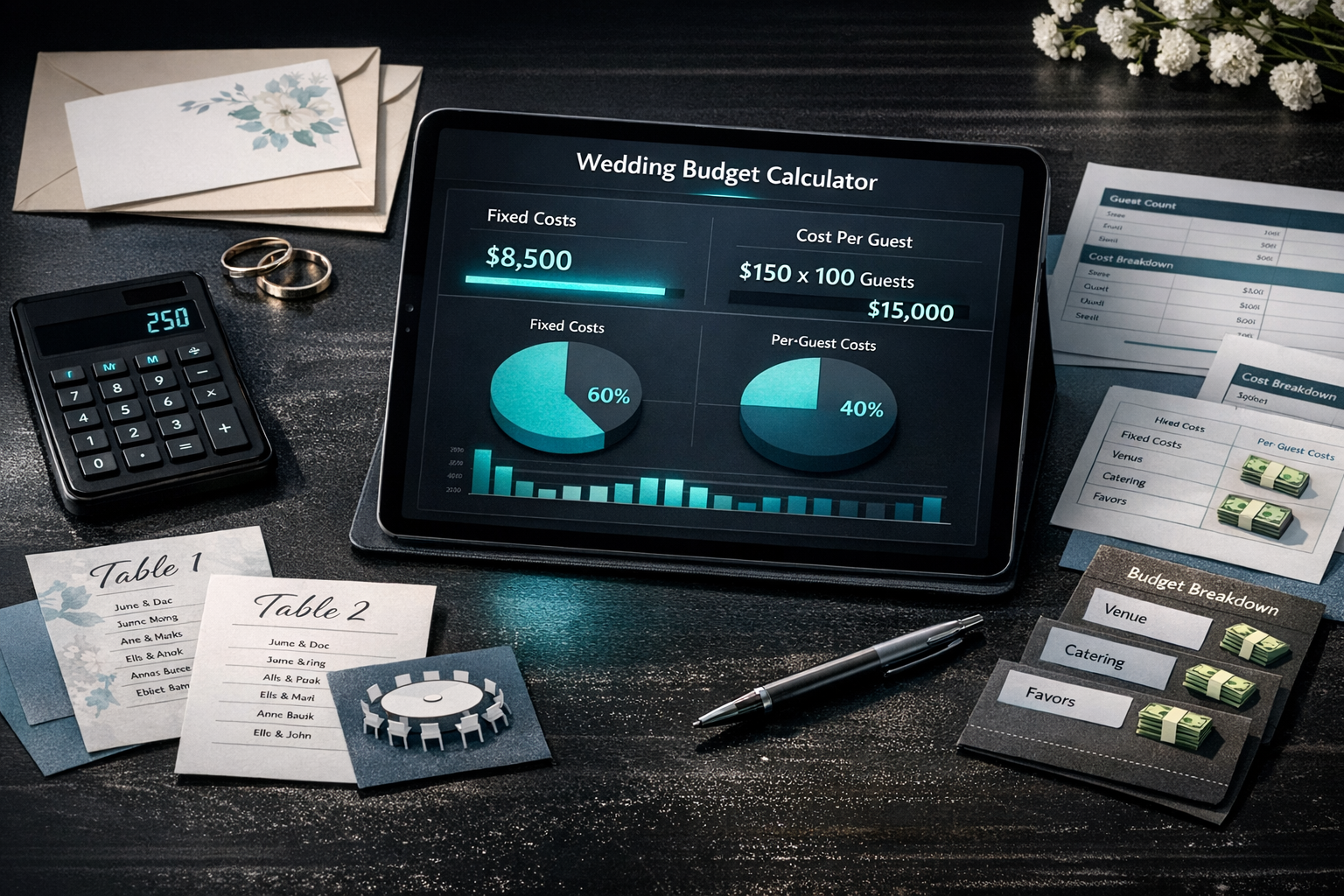
That is why I built the free wedding budget calculator around guest count instead of just giving you one big total. It helps you separate the costs that scale with every name on the list from the costs that stay fixed no matter what.
This is not a wedding-planning sermon and it is not financial advice. It is just a cleaner way to see what the day will actually cost before deposits and contract changes start stacking up.
Guest count is what moves the total fastest
A lot of couples start with a target budget and then build the wedding backward from there. That is fine until the guest count starts drifting.
One more table. A bigger bar package. Extra invitations. More chairs. Another round of rentals. Suddenly the budget no longer matches the plan you thought you had.
Guest count matters because a wedding is not one flat price. Some costs are fixed. Some rise with every person you invite. The problem is that people treat them like the same thing and then wonder why the number keeps changing.
If you are early enough in planning, guest count is the best lever you have. It is faster to adjust than venue size, menu style, or the whole vendor stack.
The calculator is useful because it forces that choice into the open. You can see what happens when you build a 75-person wedding versus a 125-person wedding versus a 175-person wedding. That is a much more honest way to plan than hoping the final invoice will be friendly.
What the wedding budget calculator by guest count actually shows
The calculator is not there to predict every vendor line perfectly. It is there to keep you from pretending the guest list is free.
Used the right way, it shows you where the money really goes:
- fixed costs that do not care much about guest count
- variable costs that scale with each invite
- a buffer so one change does not wreck the whole plan
That split matters because it keeps you from making bad tradeoffs. If you know the per-guest math, you can tell whether a bigger guest list is worth cutting something else. If you do not, you end up guessing.
I would use the calculator before I locked in a venue, before I sent invites, and before I started telling myself the budget would “probably be fine.” That is usually how budgets get wrecked.
Split fixed costs from variable guest costs
This is the part that makes the calculator actually useful.
Fixed costs
Fixed costs are the expenses that stay roughly the same even if the guest list changes. They include things like:
- venue rental
- photographer and videographer
- planner or day-of coordination
- attire and alterations
- rings
- entertainment
- officiant fees
- permits or licenses
These do not disappear just because you trim 20 guests. That is why couples can cut the headcount and still feel like the budget barely moved.
Variable guest costs
Variable costs are the ones that rise with every extra person. They usually include:
- catering
- bar service
- plates, glassware, and rentals
- seating and tables
- invitations and printed materials
- favors
- cake or dessert portions
- welcome bags or guest gifts
This is where the math gets real. If a couple thinks one more guest is just one more seat, they are missing half the bill.
Guest count also changes the feel of the event. A 50-person wedding and a 150-person wedding do not just cost different amounts. They are different planning problems.
That is why I like the guest-count view. It gives you a decision tool, not just a number.
The free calculator makes that split easier to see without building a spreadsheet from scratch.
Add a contingency buffer before deposits and changes stack up
Wedding budgets get stretched in small ways before they get blown up in big ways.
A deposit here. A quote revision there. A menu upgrade. A guest count bump. A tax or service fee that was never part of the first conversation. None of those feels huge by itself. Together they can push the total well past the comfortable range.
That is why I would build in a buffer before I started paying deposits.
Not a fake buffer. A real one.
If the plan only works with every vendor quote landing perfectly, it is not a solid plan. The buffer is there for the stuff that always happens: extra charges, late changes, and the one line item you forgot to include because you were focused on the bigger pieces.
I would rather see the real number early and decide what to cut than get surprised after I have already committed money.
How I would use the calculator before I locked anything in
I would start with the guest list I actually expect, not the one that makes the budget look clean.
Then I would run three versions of the same wedding:
- the realistic guest count
- the hopeful guest count
- the version that gives us room to breathe
That is the quickest way to see whether the event is still in range or whether the guest list is pushing the whole plan into a different tier.
If the calculator says the budget only works when the guest count stays unrealistically low, that is useful information. It means the answer is not a better calculator. It means the guest list or the venue has to change.
I would also use the calculator before I signed contracts, not after. Once deposits start hitting, every small change gets more expensive.
That is the part couples underestimate. The budget is easiest to adjust before money moves. After that, every change costs more than it should.
Where the Wedding Budget Planner Spreadsheet helps
The calculator gives you the total. The spreadsheet gives you the control layer.
That matters if you are comparing vendors, watching payment dates, and trying not to lose track of what has already been paid.
The full Wedding Budget Planner Spreadsheet adds:
- category tracking so you can see where the money is going
- deposit tracking so you know what is already committed
- vendor comparison so quotes do not blur together
- payment timing so deadlines do not sneak up on you
- budget checks so the plan stays honest as you edit it
That is the difference between knowing the rough cost and actually managing the wedding.
If you want to move from rough planning to a cleaner system, the Wedding Budget Planner Spreadsheet is the next step.
A wedding budget calculator by guest count is especially useful when the guest list is not settled yet. A lot of couples have a rough number in mind, but that number changes once parents, cousins, coworkers, and plus-ones get folded in. That is when the budget starts to drift. The calculator gives you a way to test the cost of being generous before you accidentally make the event too expensive to carry.
Who this is for
This is for couples who are still flexible on the guest list and want to understand the budget before they start locking in contracts.
It also makes sense if:
- you are trying to keep the wedding grounded in real numbers
- your guest list is still moving
- you want to know what one more table or one more round of catering does to the total
- you would rather cut with intent than get surprised later
If that sounds like where you are, the calculator is useful right away.
Who should skip it
If every major vendor is already booked and your guest count is locked, the calculator will not change the plan much.
It also is not for couples looking for a fantasy budget. If you want the prettiest version of the day without looking at the total, this will annoy you.
And if your budget is already built around fixed quotes and you just need to track payments, the spreadsheet matters more than the calculator.
If you need the tracking layer, the Wedding Budget Planner Spreadsheet handles categories, deposits, and payment timing.
My take
The guest list is the fastest way to blow up a wedding budget, so I would use a calculator that makes that visible early.
The free calculator is the fast pass. The spreadsheet is the better tool once you are actually managing the plan.
If you want to try it yourself, the wedding budget calculator by guest count is the cleanest way to see whether the guest list fits the money.
This is an estimate-only planning tool. Real costs change by venue, vendor, region, and guest count.
About the author: Chris Myers builds AI-powered business systems and tests every tool in his own solopreneur stack before recommending it. He writes at Piscion Global.