
AI Agent Build Blueprint: How to Build an AI Agent Without Overengineering It
The hardest part of trying to build an ai agent is not the code. It is deciding what to build first, what to ignore, and how to avoid overengineering the thing before it has done a single useful job. The AI Agent Build Blueprint makes sense to me as a way to shorten that gap between idea and first working version.
That is where most builders stall. They get pulled into framework debates, orchestration rabbit holes, and architecture diagrams that look impressive but do not help a user. What they need is a way to make the first version boring, useful, and small enough to finish.
I am not using this exact blueprint as a daily part of my stack, so I would not write about it like a thing I have lived inside for years. I am writing about it the way I would talk to another builder who needs a practical path, not a theory class. The value is in getting to something real without building five layers you do not need yet.
What a blueprint gives you
A blueprint is useful when you know the category of problem, but not the right implementation order. It helps you answer the first questions faster: what the agent should do, what the inputs are, where the outputs go, and how much automation is worth trusting on day one.
For a solo builder, that is often the difference between shipping and circling. A good blueprint cuts down the blank-page problem. It gives you a path from “I want an agent” to “here is the first task it can actually complete.”
That is also why I would not overcomplicate the first version. I would rather have one agent that does one thing consistently than a multi-agent setup that only works when you are staring at it. Good agent design is boring on purpose.
The first version should be smaller than you want
The biggest mistake I see is trying to build for the future version too early. Builders imagine the polished system before they have validated the task. Then they spend days wiring in memory, handoffs, state tracking, and fallback logic for a workflow nobody has used yet.
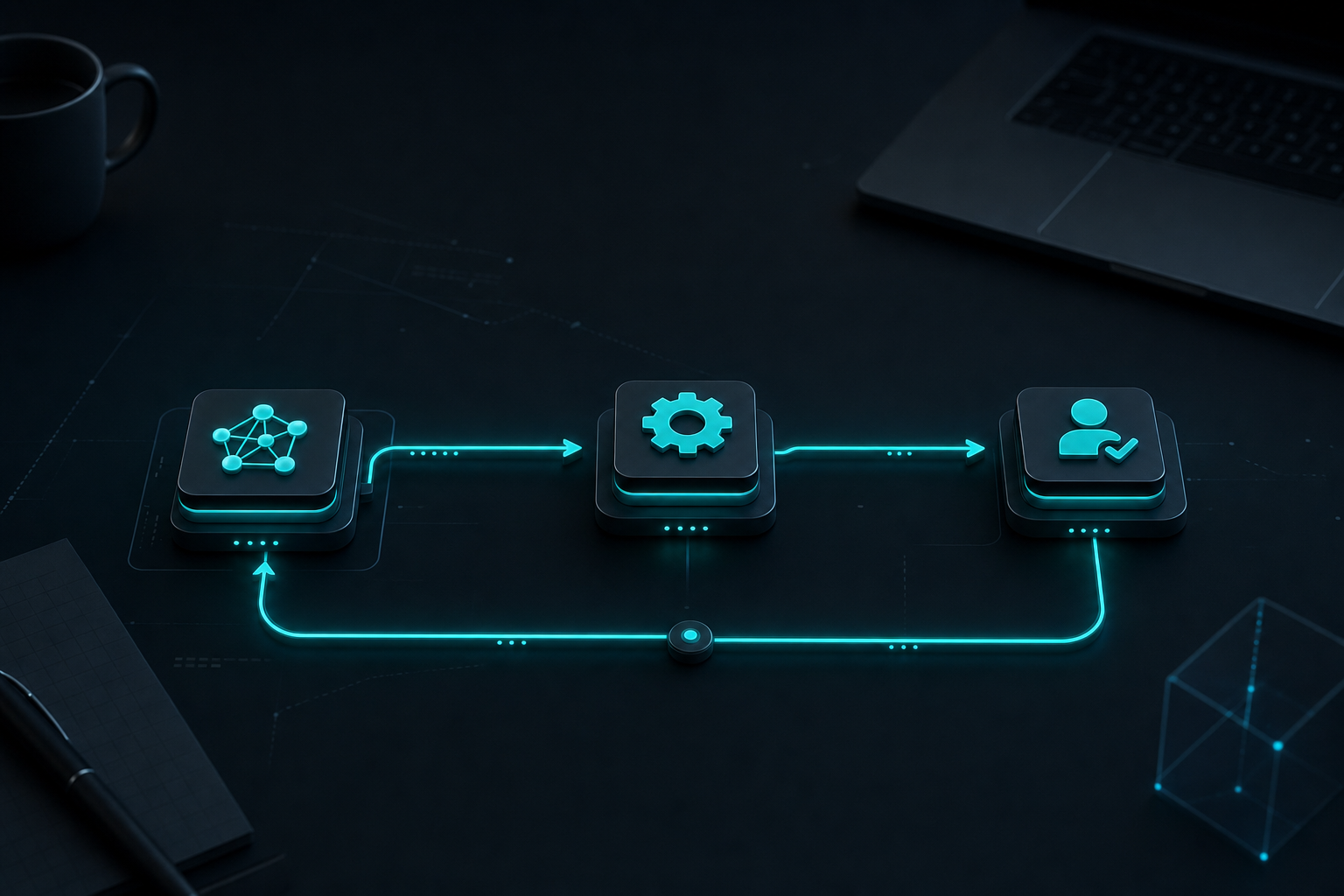
The smarter move is to start with the smallest useful loop. One input. One decision. One output. Once that works, you can add the pieces that actually prove necessary. This is where a blueprint earns its keep: it stops you from treating complexity like progress.
That lines up with the official advice from OpenAI’s guidance on building agents. I would keep the docs open while I work because the useful lesson is not “make it fancy.” It is “design the task, tools, and guardrails before you build the shell around them.” OpenAI’s function-calling docs are a good example of how the pieces fit together at a practical level.
The practical question when you decide to build an AI agent is not which framework to use — it is what repeated task is worth automating first.
If you want the longer version of the same thinking, I already wrote about AI Agent Build Blueprint: The Fundamentals Most Builders Skip. That post covers the fundamentals builders tend to skip when they get excited about the agent label.
Where the blueprint helps and where it falls short
The blueprint helps most with structure. It gives you the first pass at sequencing, task definition, and the split between what the model should decide and what should stay deterministic. That matters because the wrong split is where most agent projects get messy.
Where it falls short is decision-making that only comes from your use case. No blueprint can tell you whether your agent should talk to customers, triage data, write drafts, or just route tasks. That still belongs to you. The product can narrow the field, but it cannot choose the business problem for you.
The decision to build an AI agent is easy to make and hard to execute well — the blueprint is designed to close that gap.
That is not a weakness. It is the point. The best blueprint is the one that gets you unstuck without pretending to solve product-market fit.
Where I would use it
I would use a blueprint like this if I had a repetitive workflow that was stable enough to define but annoying enough to automate. Lead qualification, content triage, client intake, research aggregation, internal routing — those are the kinds of jobs that fit. You still need judgment at the edges, but the middle can be standardized.
I would not use it if the problem is vague. “I want an agent” is not a task. “I want something that reads incoming form submissions and drafts a response for me to review” is a task. The blueprint belongs in the second sentence.
That is also why the middle of the workflow should be small. If the task cannot be explained in one paragraph, the first build is probably too broad.
What it does not do
It does not remove the need for judgment. It does not choose the right use case. It does not replace testing. And it definitely does not make a weak workflow strong just because there is an agent sitting in the middle of it.
It also does not save you from framework churn. If you are the kind of builder who changes stack direction every week, a blueprint will only help if you are willing to stick with one version long enough to learn from it. Otherwise you are just collecting plans.
Most people who want to build an AI agent underestimate how much of the work is scope definition, not code.
For the practical shape of that path, the AI Agent Build Blueprint walks through the decisions that actually matter before you commit to a framework or start wiring tools together.
That is why I would pair the blueprint with a simple rule: do not add a layer unless you can name the failure it prevents. If the answer is “because it seems advanced,” skip it.
Who this is for
This makes sense for builders who want a practical path from idea to first working agent. It is especially useful if you are working solo, because you do not have the luxury of spinning up a team to absorb bad decisions.
It is also a fit if you are trying to build something you can maintain. Fancy is not the goal. Stable is. If a blueprint helps you make one clean decision after another, it saves you time later.
Skip it if you want a shortcut to a finished product. A blueprint is not a product. It is the part that keeps you from building the wrong thing with confidence.
What I would pair it with
If I were starting from scratch, I would pair the blueprint with a narrow model choice, one or two reliable tools, and a clear handoff to human review. I would also log the failure cases early. That gives you a better read on whether the agent should grow or stay small.
If you want to build an AI agent that handles a real job instead of a demo, start with the narrowest possible scope and verify it works before expanding.
I would keep the stack light until the workflow proves itself. That means no framework pile-on, no unnecessary memory layer, and no multi-agent circus unless the use case truly needs it. Most first versions do not.
Why build an AI agent starts smaller than you want
The hidden cost of building an agent is not the tokens. It is the time you spend changing direction because the system is too broad. Every extra layer means another thing to test, another thing to break, and another thing to explain later. A blueprint helps because it forces a decision before the code starts multiplying.
If you keep the first build small, you can learn faster from real usage. That means fewer assumptions, fewer dead ends, and less cleanup later. It also means the first useful version can land sooner, which is the only thing that matters when you are trying to validate an idea.
The first hour you spend trying to build an AI agent correctly — defining the task, the trigger, and the failure mode — saves ten hours of debugging later.
The blueprint gives you a structured approach to build an AI agent that is narrow enough to finish and useful enough to keep.
I would use that as the real price test. If the blueprint saves you from a week of architecture detours, it probably pays for itself before the agent ever goes live. If it only gives you a prettier plan, you are still ahead because at least you know what not to build.
The best outcome is not a giant system. It is a first working loop that does one job without making you babysit it every hour.
What I would keep out of the stack
I would keep the first build free of anything that exists mostly to impress other builders. That means no extra framework layer unless it is carrying a real burden, no memory system unless the use case truly needs it, and no elaborate multi-agent choreography unless one agent cannot do the job safely by itself.
The quickest way to lose momentum is to build something that requires ongoing explanation. If you cannot explain the stack to yourself in plain language, the architecture is probably ahead of the product. A blueprint helps because it makes the first cut obvious: what belongs in version one and what can wait.
That is the part I value most. Not the promise of a bigger system. The discipline to keep version one useful.
Worth it or not
My verdict is that a blueprint is worth it if your real problem is getting to a usable first version without getting lost in architecture. If your real problem is deciding the business use case, this is not the first thing you need.
If you want to try it yourself, AI Agent Build Blueprint is the link I would use. It is the fastest way to see whether the blueprint fits the way you want to build.
Use my link if it helps. I may earn a commission at no extra cost to you, and the price is the same either way.
Pingback: The Exact Tool Stack I'd Use to Build an AI Agency Today
Pingback: How I'd Build an Agentic Stack for a Small Business Client from Scratch