
A freelance client intake questionnaire should collect the goals, audience, scope, assets, deadlines, budget, and approval details you need before work begins. Send it after the client says yes and before the kickoff call. That way, the call can resolve decisions instead of becoming an hour of basic fact-finding. Once the answers are in, use a structured freelance client kickoff meeting agenda to confirm what matters and assign the next steps.
The form does not need to be long for the sake of looking professional. It needs to expose missing information while there is still time to clarify it. The 19 questions below are organized around the decisions each answer should unlock.
Key takeaways
- Ask for facts before kickoff so the live conversation can focus on choices, conflicts, and open questions.
- Group questions by the decision they support: goals, audience, scope, timing, money, assets, access, and approvals.
- Do not treat a vague answer as complete. Flag words such as “modern,” “ASAP,” and “a few revisions” for follow-up.
- Transfer confirmed answers into the contract, timeline, kickoff agenda, and change process instead of leaving them trapped in a form.
- A simple form can be enough for a small job. A connected onboarding system helps when several documents depend on the same answers.
Why should client intake happen before the kickoff meeting?
Client intake should happen before kickoff because the two steps do different jobs. The questionnaire gathers information asynchronously. The kickoff call confirms the information, resolves ambiguity, and gives each person a clear next action.
If you wait until the call to ask who approves the work, where the source files live, or what the deadline actually means, you spend the meeting collecting details the client could have supplied earlier. Worse, you may discover halfway through the call that the budget, requested deliverables, and timeline do not fit together.
Send the questionnaire when the project is commercially real: after the client has agreed to move forward, but before production starts. If your process requires a signed contract and deposit first, keep that gate. The questionnaire is not a substitute for either one. It is the bridge between “yes” and a workable project plan.
Give the client a firm return date and explain why you need the answers. “Please return this by Tuesday so I can prepare the timeline and use our kickoff call to settle open decisions” is clearer than sending a form with no context.
What should a freelance client intake questionnaire ask?
A useful intake form asks only for information that changes the work, the schedule, the commercial terms, or the approval path. These 19 questions cover eight decision areas. Adapt the wording to your service and remove anything that cannot affect delivery.
1. Goals and success criteria
- What is the main business outcome this project needs to support?
This forces a priority. “We need a website” describes an output; “we need qualified prospects to request estimates” explains what the output must help accomplish. - What would make you consider this project successful?
Ask for an observable condition where possible: a completed launch, a usable sales asset, fewer support questions, or a defined internal handoff. Do not promise the result. Record how the client will judge the work. - Which goal matters most if we have to make a tradeoff?
This answer helps when speed, polish, breadth, and budget pull in different directions.
2. Audience and message
- Who is the primary audience for this work?
Ask for one primary group, not “everyone.” Role, situation, level of knowledge, and buying context are usually more useful than a broad demographic label. - What does that audience already know, believe, or misunderstand?
This shapes the amount of explanation, the examples, and the language the work needs. - What action should the audience take after seeing the finished work?
A defined next action helps prevent a deliverable from becoming informative but directionless.
3. Scope and deliverables
- What exact deliverables do you expect at the end of the project?
Ask for formats, quantities, sizes, platforms, and variants. “Social graphics” might mean five static posts or a month of multi-format assets. Those are different jobs. - What is explicitly outside this project?
This is easier to answer before work starts than after an extra request appears. Put the confirmed exclusions in the scope section of the contract. - How many review rounds do you expect, and who can request changes?
Separate a review round from unlimited edits. If several stakeholders can comment, require consolidated feedback from one owner.
4. Timing and dependencies
- What is the required completion date, and what creates that date?
A launch, event, board meeting, ad booking, or internal deadline carries different risk. “ASAP” is not a date. - Are there review dates or milestones that cannot move?
A final deadline alone hides the client-side approvals that can delay the schedule. - What must the client provide before each phase can begin?
Name dependencies such as copy, credentials, photos, legal approval, inventory data, or stakeholder feedback.
5. Budget and payment
- What budget has been approved for this project?
If price is already agreed, use this to confirm that both sides are still working from the same number and that requested extras are not silently assumed. - Who handles invoices, purchase orders, and payment approval?
The person directing the project may not control accounts payable. Get the right contact and any required billing details early.
6. Assets and access
- Which existing assets should be used, and where are the current versions stored?
Ask about brand files, copy, photos, research, account credentials, templates, analytics, and prior work. “We have a logo” is not the same as having the correct vector file. - What systems or accounts will require access, and who can grant it?
Use secure access methods appropriate to the system. Do not ask clients to paste passwords into the questionnaire.
7. References and competitors
- Which examples feel close to the direction you want, and what specifically works about each one?
The reason matters more than the link. A client may like the layout of one example, the tone of another, and the checkout flow of a third. - Which competitors or alternatives should we understand, and how should this project differ?
This gives context without turning the project into a copy of someone else’s work.
8. Decision-makers and approval
- Who gives final approval, and who else must be consulted before that decision?
Record one final approver. If legal, finance, a founder, or another department must review the work, put those checkpoints into the timeline.
These questions create a practical baseline, but the client’s first answer is not always the usable answer. The next step is to identify where the response still leaves you making assumptions.
Which intake answers need clarification before work starts?
Clarify any answer that can support two reasonable interpretations. You are looking for vague language, internal contradictions, missing owners, and dependencies with no due date.
- Vague quality words: “clean,” “premium,” “professional,” and “modern” need examples or defined characteristics.
- Open-ended quantities: “some posts,” “a few pages,” or “multiple versions” need a number and format.
- Unowned decisions: “the team will review it” needs a named person who consolidates feedback and approves the result.
- Conflicting constraints: a fixed deadline, broad scope, and limited budget require an explicit priority.
- Missing dependencies: “we will send the copy later” needs an owner, date, and stated effect on the project schedule.
- Undefined revisions: “until it is right” needs a review-round limit and a change process.
Do not correct these silently in your own notes. Put the unresolved item in the kickoff agenda and record the final decision afterward. When the client asks for something outside the confirmed boundary later, a documented scope-change conversation is much easier than debating what each person remembers.
How do intake answers feed the contract, timeline, and kickoff?
Intake has value only when its answers move into the documents that control the project. Treat the form as input, not as the final record.
Move scope answers into the contract
Transfer deliverables, quantities, formats, exclusions, revision limits, client responsibilities, and the approval owner into the agreement or statement of work. If the questionnaire and contract disagree, resolve the difference before production begins.
Move dates and dependencies into the timeline
Build the schedule from both freelancer tasks and client obligations. For example, a page-design milestone may depend on approved copy by May 8, review comments by May 12, and final approval by May 15. If the client misses an input date, the downstream date should not remain magically fixed.
Move ambiguity into the kickoff agenda
Do not reread all 19 questions on the call. Share a short list of open decisions: which audience is primary, which five pages are included, whether legal review is required, and who gives final approval. The meeting then produces decisions instead of duplicate answers.
Move communication preferences into the operating rhythm
Confirm where updates will live, how often they will be sent, the expected response window, and how feedback should be consolidated. A written freelance client communication process keeps those rules consistent after the kickoff call ends.
Worked example: turning a vague website request into a usable brief
Suppose a client writes, “We need a modern five-page website by the end of the month.” It sounds specific because it contains a style, quantity, and deadline. It still leaves several decisions open.
The intake answers reveal that the main goal is estimate requests from local commercial buyers. The five pages are Home, Services, Industries, About, and Contact. The client has a logo but no approved copy or project photos. The operations manager will supply technical details, while the owner gives final approval. A trade-show booth booking creates the deadline.
That information changes the plan:
- “Modern” becomes a reference discussion about clear navigation, restrained color, and prominent estimate-request paths.
- Copywriting and photo selection must be included, excluded, or assigned to the client.
- The timeline needs dates for technical input, copy review, photo delivery, and owner approval.
- The contract needs five named pages, the agreed revision rounds, and a process for adding pages.
- The kickoff call only needs to settle unresolved references, content ownership, and approval dates.
No questionnaire guarantees that the project will run perfectly. It does make the unknowns visible before those unknowns become rework.
When is a questionnaire enough, and when does a full onboarding system help?
A standalone form can be enough when the job is small, the deliverable is narrow, one person approves the work, and you already have reliable contract, payment, and communication documents. Use the simplest process that still protects the project.
A broader system helps when the same answers must appear across several places. The approval owner affects the kickoff and review process. The deliverables and exclusions affect the contract. The deadline and dependencies affect the schedule. The billing contact affects invoicing. If you copy these details manually into disconnected documents, contradictions become easier to create.
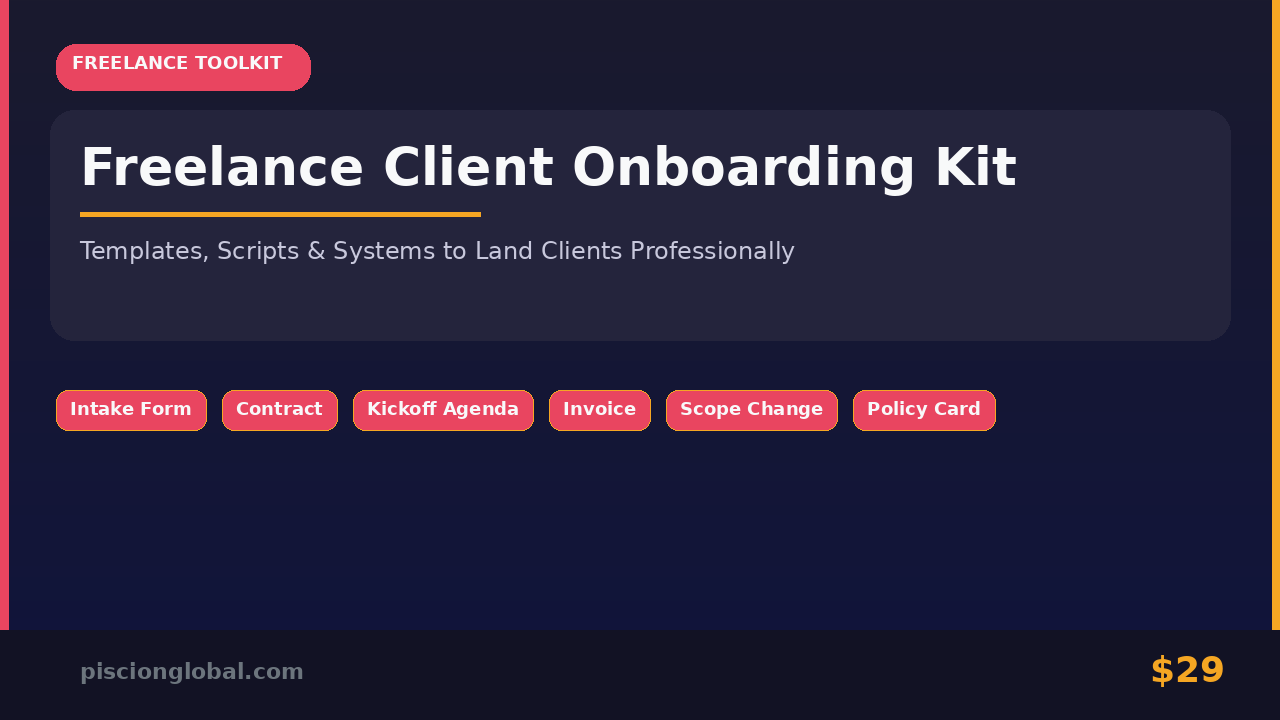
The Freelance Client Onboarding Kit is built for that connected use case. The verified $29 kit contains seven components: a 19-question intake questionnaire across eight sections, plus a welcome packet, contract, kickoff agenda, invoice and payment schedule, scope-change form, and communication and revision policy card.
It will not make unclear clients clear on its own, and it does not replace your judgment about scope, pricing, or risk. It gives you a consistent set of documents to customize so the information collected before kickoff can keep working after the call. The broader Freelance Client Onboarding Kit review breaks down the package if you want to see how the pieces fit before deciding.
A simple pre-kickoff workflow
- Confirm the commercial gate your process requires, such as a signed agreement and deposit.
- Send the intake questionnaire with a return date and a one-sentence reason for each major section.
- Review the answers before the call. Highlight ambiguity, conflicts, missing files, and unnamed approvers.
- Update the draft scope and timeline using confirmed facts.
- Build the kickoff agenda around unresolved decisions, not around questions the client already answered.
- After the call, send a written recap and update the controlling project documents.
About the author: Chris Myers builds practical systems for running a lean business while working a full-time job. He writes at Piscion Global for solopreneurs who need useful processes without extra overhead.
Use the intake answers after the form is submitted
The best questionnaire is not the one with the most fields. It is the one that catches a missing decision before the missing decision costs time. Start with the 19 questions above, remove anything that does not affect your work, and add service-specific questions only when the answer changes delivery.
If you already have the rest of your onboarding documents, a focused form may be all you need. If you want the questionnaire connected to the contract, kickoff, payment, scope-change, welcome, and communication materials, get the Freelance Client Onboarding Kit for $29 and customize it around your service.