
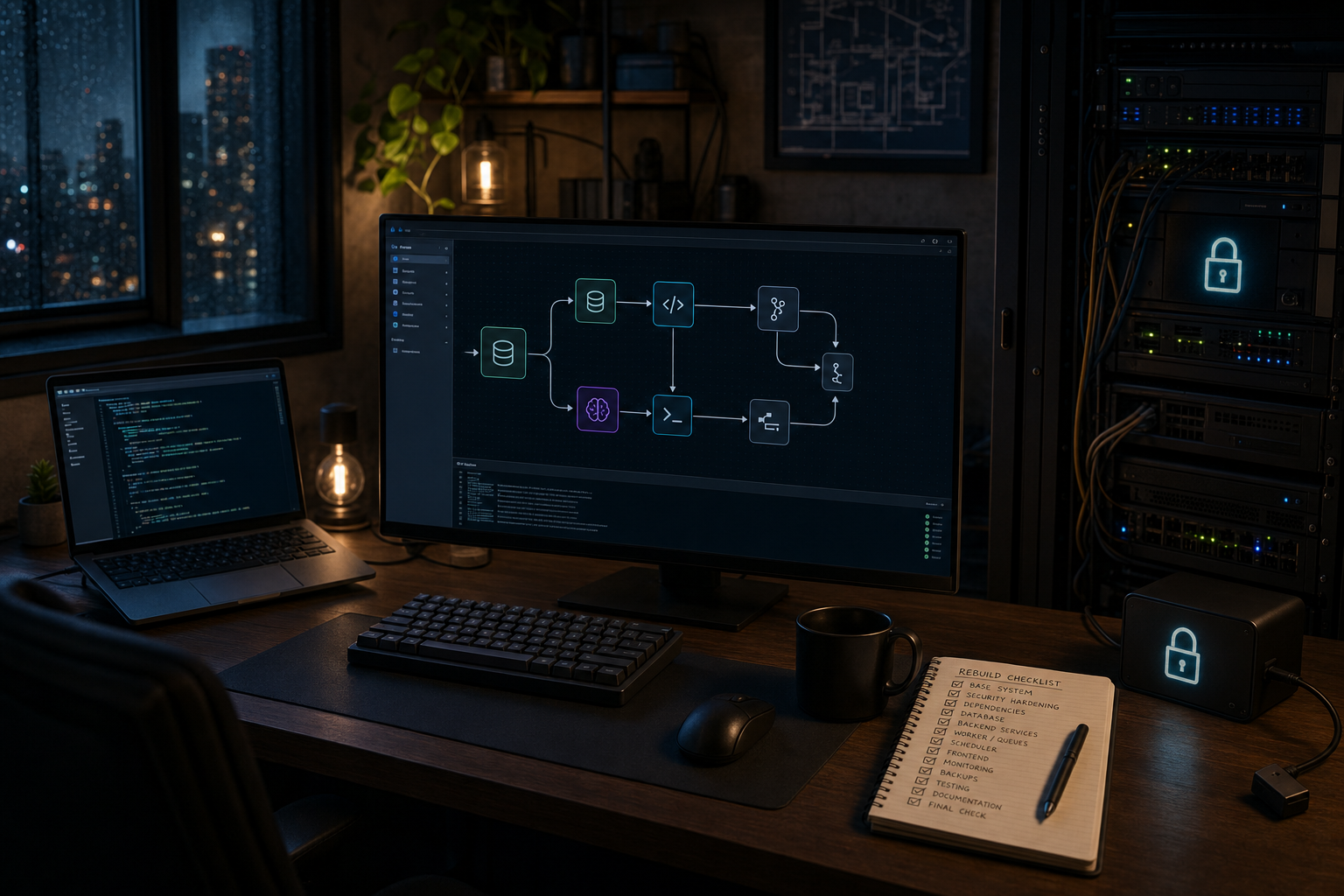
AI Agent Pipeline Rebuild VPS: How I Rebuilt Mine From Scratch in One Day
I ended up doing an AI agent pipeline rebuild VPS style reset because patching the old stack had become slower than rebuilding it. Once the errors started crossing agent boundaries, I stopped trying to nurse the thing back to life and treated it like a clean-slate job.
That was the right call. I kept the pieces that still worked, threw away the parts that were eating time, and rebuilt the whole pipeline in one day with a preserve-first plan. The point was not to make it fancy. The point was to get back to something I could trust.
What surprised me was how much of the rebuild came down to boring discipline. The stack got stable again because I stopped improvising around secrets, stopped letting the executor layer drift, and forced the pipeline to stay small enough to understand. That is the part people skip when they talk about autonomous systems. That is the kind of work that makes an AI agent pipeline rebuild VPS actually stick.
I’m writing this because a lot of people want the result — an agent stack that can actually run — without the reset work. That usually means they keep dragging one broken piece after another across the finish line. I did that for too long. The rebuild fixed the real problem.
Quick answer:
- Why the AI agent pipeline rebuild VPS reset beat another patch.
- The preserve-first rebuild plan.
- Secrets, executors, and the parts that had to be boring.
- The Codex harness issue forced a clean diagnosis.
- What I would keep if I had to do it again.
Why the AI agent pipeline rebuild VPS reset beat another patch
The old pipeline was not broken in one dramatic way. It was broken in the usual way: a little here, a little there, until every fix added another place for failure to hide. One agent would start, another would miss context, and a third would inherit some stale assumption that was never supposed to survive a restart.
That is where the AI agent pipeline rebuild VPS idea stopped being theoretical and turned into the only sane option. I could keep patching the same seams, or I could clean the room and put the parts back in order. I chose the second option because I wanted to know exactly what was in the system and why it was there.
The biggest difference was that I stopped treating the pipeline like a collection of clever tricks. I treated it like a piece of infrastructure. If something mattered, it had to be recoverable. If it could not be rebuilt from notes and files, it did not belong in the stack. That is the basic rule behind any AI agent pipeline rebuild VPS worth doing.
That meant I had to answer a basic question before I touched anything: what actually needs to survive a reset? Not everything does. A lot of agent plumbing is just scaffolding. The mistake is keeping scaffolding around because it looks like progress.
The preserve-first rule came out of that. I kept the parts that were proven, documented, and easy to reattach. I cut the parts that depended on memory, manual steps, or fragile state. That was the fastest way to make the rebuild boring in a good way.
The preserve-first rebuild plan
The rebuild only worked because I started by preserving the things that were already doing their job. I did not try to redesign the whole system in the middle of the reset. That would have turned one day of work into a week of debate.
I made a reconnect kit first. That kit held the minimum information needed to bring the system back online without guessing: the shape of the stack, the order of the parts, the secrets handling, and the known failure points. That one move kept me from rebuilding blind.
I also separated what was essential from what was merely convenient. A lot of rebuilds fail because people try to restore the old comfort layer too early. They want the old shortcuts back before the core system is working. I did the opposite. I rebuilt the core first, then added the convenience layers back only if they still made sense.
That approach saved time because it removed decision fatigue. When the stack is half-broken, every extra choice costs more than it should. By reducing the rebuild to a small set of known moves, I made it possible to finish in a day instead of spiraling into a refactor.
The other thing I preserved was the operational memory, not the code itself. I wanted the reasons behind the architecture to survive, because those reasons matter more than the exact commands. If you do not preserve the why, you end up recreating the same mistake with a fresh folder name.
For the same reason, I kept the stack readable. No hidden magic. No buried one-offs. If I could not explain a component in plain language, it had no business being part of a one-person automation pipeline.
Secrets, executors, and the parts that had to be boring
The unglamorous part of the rebuild was the one that mattered most: secrets management. I used age because I wanted encrypted secrets that were simple enough to trust and fast enough not to slow down the work. That was not about looking sophisticated. It was about removing one more reason for the pipeline to break.
The executor choice mattered too. I used Claude Code as the build executor because I wanted a tool that could do the actual work without turning the process into a tangle of manual handoffs. The agent layer can only stay useful if the execution layer is predictable. Once that starts wobbling, the whole stack starts lying to you.
That is also why I kept the commands and file paths boring. A clean rebuild depends on repeatability. If a step has to be remembered from memory, it is already too fragile. If it has to be explained twice, it probably belongs in a file. The AI agent pipeline rebuild VPS only made sense because the steps were simple enough to repeat.
This is the part of the story that does not look impressive from the outside, but it is the reason the day finished cleanly. I did not need a more powerful agent stack. I needed a less brittle one.
I also leaned hard on the idea that a good agent pipeline should fail in visible ways. If something is going to break, I want the break to point at the actual cause, not hide behind a few layers of abstraction. That was one of the reasons the rebuild felt like progress instead of just a fresh coat of paint.
The same mindset is why I kept the system small enough to inspect. When a pipeline gets too wide, the operator becomes a spectator. That is when the automation starts running you instead of the other way around.
The Codex harness issue forced a clean diagnosis
The real turning point was the Codex harness root cause diagnosis. Once that showed up, I had to stop assuming the failure was in the obvious place. It was easy to blame the model, easy to blame the agent, and easy to blame the machine. None of those guesses would have helped.
What I needed was a clean diagnosis path. I traced the issue through the build surface instead of trying to patch symptoms. That matters because agent systems often fail in the layer between intention and execution, not in the part people are staring at.
The harness problem told me something useful: a system can look alive while the operating surface is already drifting. That is dangerous in an autonomous stack. If you do not catch that drift early, the pipeline keeps producing activity without producing trust.
That diagnosis pushed the rebuild in the right direction. It confirmed that I did not need more complexity. I needed tighter control over the execution boundary. The pipeline had to become easier to reason about than it was before. That is what turns an AI agent pipeline rebuild VPS from a theory exercise into a working stack.
This is also where I’m glad I rebuilt from scratch instead of trying to keep the old structure intact. A clean reset makes the failure obvious. A patched system invites you to rationalize the failure away.
If you build these systems long enough, you learn that the story is usually not “the agent failed.” It is “the boundary between pieces was never as clear as it looked.” That was the lesson here.
What I would keep if I had to do it again
If I had to repeat the rebuild tomorrow, I would keep the same order.
First, I would write the reconnect kit before touching the stack. That is the fastest way to stop the rebuild from turning into a memory test.
Second, I would preserve the parts that already work and remove the rest without guilt. A rebuild is not a moral event. You do not get points for keeping broken structure alive longer than necessary.
Third, I would keep the executor layer plain. Fancy is not a virtue when you are trying to restore trust in a pipeline. Repeatable is.
Fourth, I would keep secrets isolated and encrypted from the start. Once secrets handling gets casual, the rebuild is already compromised. OpenClaw only stays useful as a control layer if the operator can trust what lives around it.
And fifth, I would keep the stack smaller than my ambition. That is the part most people resist. The system does not have to be able to do everything. It has to be able to do the next useful thing without becoming brittle.
That is the actual value of the rebuild. Not just that it worked, but that it came back in a form I could understand.
Who this is for and who should skip it
This approach makes sense if you are a solopreneur or developer trying to run an agent stack on your own infrastructure and you care about recovery more than appearances. It fits if you are comfortable on a VPS, can read your own logs, and would rather own the mess than rent someone else’s abstraction.
It is not for people who want a click-through hosted platform to hide the hard parts. If you want managed automation, use a managed tool. If you want simple task help, use a hosted assistant and stop there. There is no shame in that. It is just a different job.
This is also not for anyone who thinks the answer is always a bigger framework. Bigger frameworks usually add more surface area before they add clarity. If your stack is already unstable, more layers will not save you.
If you do want the self-hosted path, this is the kind of rebuild that pays off: keep the working pieces, document the handoffs, encrypt the secrets, and make the system small enough to trust again. That is what got me from broken to usable in one day. For an AI agent pipeline rebuild VPS, that is the difference between being stuck and being operational.
If you want the related architecture breakdown, read OpenClaw Autonomy: Why the Orchestration Layer Matters More Than the Model.
That is my verdict: the AI agent pipeline rebuild VPS reset was worth it because it gave me back a stack I could actually operate. Not because it was flashy. Because it was recoverable.
About the author: Chris Myers builds AI-powered business systems and tests every tool in his own solopreneur stack before recommending it. He writes at Piscion Global.
Pingback: Verdent AI Review 2026: AI Writing That Doesn't Sound Like AI